darkgray-mallard-260384.hostingersite.com
- hisolar@operasolar.com.au
The Battery Rebate Drops on 1 Jan 2027: Don’t Miss Out on Huge Savings Up to A$6,800 Get Rebate


Home EV Charger Installation
The Ultimate Sydney Guide
Compare the best home EV chargers in Australia. Read our 2026 definitive guide on Home EV Charger Installation Sydney featuring Zappi, Tesla, Evnex, and GoodWe.
Quick Update on the April 30 Battery Rebate:
Thanks to massive local demand, the Opera Solar team is fully booked for the rest of April. This means any new battery orders will be installed from May onwards, and will fall under the new rebate rates starting May 1.
While the maximum April rebate has passed, the May rebate is still a great way to save on your battery. Please reach out today to secure your spot in our May schedule before those dates book out too.
Key
Insights
Planning a home EV charger installation is the most critical step you will take after purchasing an electric vehicle. While standard wall sockets provide an incredibly slow trickle of power, upgrading to a dedicated smart wall box fundamentally changes the EV ownership experience. It allows you to charge your Electric Vehicle (EV) safely overnight, take advantage of cost-effective off-peak energy tariffs, and integrate directly with rooftop solar panels.
This home EV charger installation Sydney guide provides an objective, jargon-free breakdown of charging speeds, hardware costs, and the exact switchboard requirements needed to prepare your Sydney property for electric mobility.
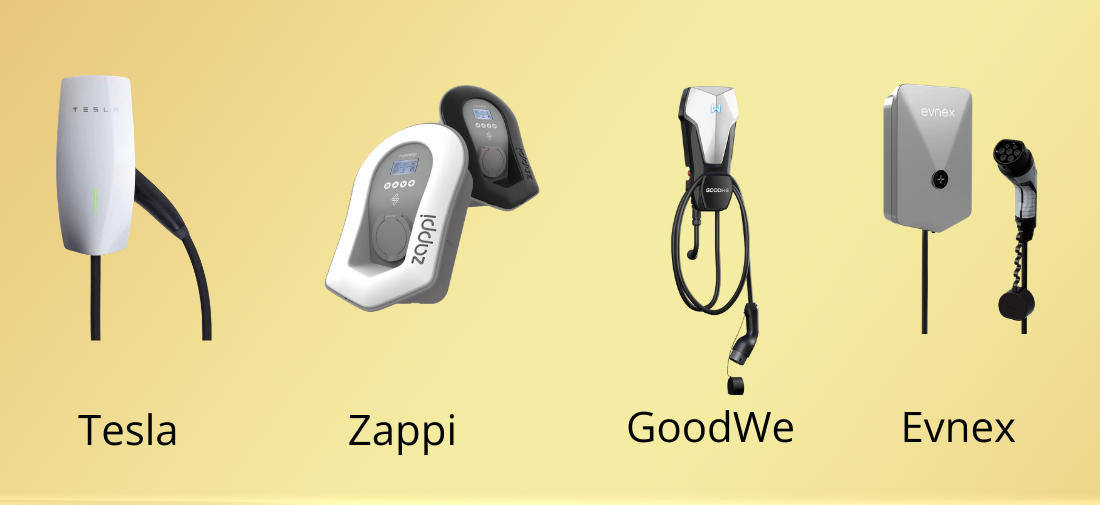
Top Smart EV Chargers for Australian Homes:
Zappi
Widely regarded as a leader in solar-aware technology, specifically designed to maximise the use of excess rooftop solar power.
Tesla Wall Connector
A sleek, universally recognised unit that provides highly reliable charging for all Type 2 electric vehicles, not just Tesla models.
Evnex
A premium New Zealand engineered smart EV charger Australia loves for its deep grid-awareness and highly intuitive smartphone application.
GoodWe
The perfect hardware expansion for homes already running a GoodWe solar inverter, creating a seamless, single-app energy ecosystem.
The Ultimate Setup: Combining an EV charger with a complete Solar and Battery System can significantly improve your energy independence and reduce long-term electricity costs.
Why Home Charging is
the Smartest Move
The transition from a petrol or diesel car to an electric vehicle is an exciting step. However, relying entirely on public charging infrastructure can quickly become a hassle. Public fast chargers are often occupied, occasionally out of order, and typically charge higher rates than standard residential electricity.
To achieve true convenience and total cost control, you need the ability to wake up every morning with a fully charged vehicle—so you never have to second-guess taking a long drive. Installing a dedicated charging point at home is the most effective way to avoid rising public charging costs and simplify your daily routine.
By making a strategic upfront investment in the right wall box, you turn your home into a private, highly efficient charging station.
The Basics: What is a Dedicated
Home EV Charger?
When you first bring your electric car home, the charging options can seem confusing. To make an informed decision, you need to understand the fundamental difference between the cable that came in the boot of your car and a permanently installed wall box.
Level 1 vs. Level 2 Charging Speeds
The speed at which your car battery fills up is dictated by the level of power your home can safely deliver.
Level 1 Charging (The Wall Socket)
Often referred to as a “granny charger,” this is the portable cable that plugs into a standard 10-amp household power point. It is incredibly slow. A Level 1 cable typically adds about 10 to 15 kilometres of driving range per hour of charging. If you own a large electric SUV with a massive battery pack, plugging it into a standard wall socket could take well over 30 hours to reach a full charge. While it is useful in an emergency, it is not a practical daily solution.
Level 2 Charging (The Dedicated Wall Box)
A Level 2 charger installation involves hardwiring a dedicated unit directly to your home switchboard. This hardware allows for higher current delivery through a dedicated electrical circuit. A standard single-phase Level 2 charger delivers 7.4kW of power, which adds roughly 40 to 50 kilometres of range per hour. If your home has a three-phase connection, a 22kW charger can add over 120 kilometres of range per hour. This speed ensures that even the largest electric vehicles can be fully recharged comfortably overnight.
Tethered vs. Untethered Wall Boxes
When selecting your hardware, you will need to choose between a tethered and an untethered unit.
Tethered Chargers
These units feature a permanent cable built directly into the wall box. The primary advantage is sheer convenience. You simply park your car, grab the plug off the wall, and plug it straight in.
Untethered Chargers
These units act as a universal socket on your wall. You must use the separate charging cable provided with your vehicle to connect the car to the box. The advantage here is long-term flexibility. If plug standards ever change in the future, you only need to buy a new cable rather than replacing the entire wall box.
Charging Your EV with Solar Power
(The Opera Solar Approach)
If you own a residential solar system, your electric vehicle represents a major financial opportunity. Instead of exporting your valuable daytime solar energy back to the grid for a minimal 5-cent feed-in tariff, you can use that exact same power to fuel your car.
How Solar-Aware EV Chargers Work
Charging an EV with solar panels requires intelligent hardware. A standard EV charger simply pulls power blindly. If your solar panels are generating 3kW but your car demands 7kW, the standard charger will automatically pull the missing 4kW from the expensive street grid—which is exactly what drives up most EV charging costs.
A “solar-aware” smart charger operates entirely differently. During the installation, we place a small monitoring clamp inside your switchboard. This clamp actively reads how much solar power your house is exporting to the street in real time. The smart charger then dynamically adjusts its own charging speed to match that exact export figure. If a cloud passes over your house and solar production drops, the charger instantly slows down. This ensures your car is powered almost exclusively by sunshine, making your daily commute highly cost-effective.
Why We Recommend Solar & Battery Combinations
Relying entirely on daytime solar charging is brilliant if your car is parked at home during the week. However, many suburban professionals commute every day and only park in their garage at night.
This is where a Solar EV charging Sydney strategy becomes highly sophisticated. By pairing your rooftop solar array with a home storage battery, you capture the free daytime sunshine, store it, and then discharge that clean energy into your car when you plug in after work. Even if you do not have a home battery yet, installing a smart charger today future-proofs your garage. It sets the foundation for a fully integrated energy ecosystem when you are ready to upgrade.
Top EV Charger Brands for
Australian Homes
The market is currently flooded with generic charging units. To ensure long-term reliability and safety, we strongly suggest investing in proven, Tier 1 hardware. Here are the platforms we trust for Australian residential installations.
Zappi:
When it comes to solar integration, a Zappi EV charger installation is widely considered the gold standard. Manufactured by myenergi, the Zappi was built from the ground up to prioritise renewable energy. It features three distinct charging modes: Fast, Eco, and Eco+.
In Eco+ mode, the Zappi acts as a strict gatekeeper. It is designed to strictly prioritise charging your vehicle using excess solar power. If the sun goes down, the charging pauses. This gives you total control over your electricity bill. It is slightly bulkier than other units, but its internal software and solar tracking capabilities are widely regarded as among the best in the industry.
Tesla Wall Connector:
Many homeowners mistakenly believe they must own a Tesla vehicle to use Tesla hardware. This is entirely incorrect. The Gen 3 Tesla wall connector Sydney homeowners frequently install uses the universal Type 2 plug standard. This means it can safely charge a BYD, a Polestar, a Hyundai, or a Kia.
The Tesla unit is beautifully designed with a sleek glass faceplate and a highly refined cable management system. While its direct solar tracking capabilities are not as deep as the Zappi, it is incredibly reliable, updates its software automatically via Wi-Fi, and offers a highly seamless app experience.
Evnex:
Evnex is a premium brand engineered in New Zealand, built specifically to handle the demands of local power grids. An Evnex smart charger provides a highly refined user experience through a brilliant smartphone application.
One of its standout features is its deep grid awareness. It easily integrates with complex time-of-use energy tariffs. You can simply plug your car in at 6:00 PM, use the Evnex app to tell the charger you want the car full by 7:00 AM, and the software will automatically wait until midnight, when electricity prices are typically at their lowest before it begins pulling power.
GoodWe:
If your home already features a GoodWe solar inverter or a GoodWe battery stack, selecting a GoodWe compatible EV charger is a highly strategic move.
Instead of juggling three different smartphone apps to manage your home energy, the GoodWe charger integrates directly into the existing GoodWe SEMS portal. You can view your solar generation, your battery storage capacity, and your vehicle charging status all on a single screen. It offers seamless communication between the inverter and the charger, ensuring your excess solar power is diverted into the vehicle with high precision.
Each of these chargers serves a different purpose—choosing the right one depends on whether you prioritise solar tracking, sleek design, smart grid scheduling, or seamless ecosystem integration.
How Much Does an EV Charger
Cost in 2026?
Understanding the total cost is essential before committing to an upgrade. The final price is always split into two distinct parts: the hardware itself and the professional electrical installation.
Hardware and Installation Price Guide
For premium hardware like Zappi, Tesla, or Evnex, you can expect the wall box itself to cost anywhere from $1,200 to $2,000 depending on the model and the cable length.
The actual cost to install EV charger hardware is highly variable because every Sydney home is physically different. A straightforward installation where the charger is mounted directly on the wall backing onto your main switchboard usually ranges between $800 and $1,200. However, if your garage is detached, or if our electricians need to run thick cabling through complex roof cavities or under brick pavers, the labor and cabling costs can increase to $1,500 or more.
In most cases, homeowners can expect a total installed cost between $2,000 and $3,500 depending on site conditions and hardware selection. We always conduct a thorough site assessment to provide a strict, fixed-price quote.
Are There Any EV Charger Rebates in NSW?
Financial incentives for electric vehicles change frequently. As of 2026, it is important to know exactly where things stand. There are currently no direct NSW government cash rebates available for standard, freestanding residential home EV charger installations.
While some vehicle manufacturers occasionally offer a promotional charger inclusion when you buy the car, the state government does not send you a cheque to offset the electrician’s invoice. This makes choosing highly reliable hardware even more important, as you want to ensure your initial capital investment lasts for over a decade.
A properly installed EV charger is not just a convenience upgrade, but in fact, it’s a long-term investment that can significantly reduce your ongoing transport costs.
Important Requirements
Before You Install
You cannot simply buy a wall box online and expect it to operate safely and efficiently. The electrical infrastructure of your property dictates exactly what hardware you can legally and safely deploy.
Single-Phase vs. Three-Phase Power Limits
The most critical factor is the main power cable connecting your house to the street grid. This dictates the single-phase vs three-phase EV charger debate.
The vast majority of standard suburban homes operate on a single-phase connection. This limits your charging hardware to a maximum speed of 7.4kW. Upgrading to a three-phase connection just to achieve 22kW charging speeds is generally an unnecessary expense for a residential property, as 7.4kW is more than enough to fully recharge a car overnight. If your property already possesses a pre-existing three-phase connection due to heavy ducted air conditioning, then installing a 22kW charger is a brilliant way to utilise that infrastructure.
Switchboard Capacity and Dynamic Load Balancing
Your home switchboard has a strict maximum capacity, usually governed by a 60-amp or 80-amp main service fuse. An EV charger running at full speed can draw up to 32 amps of continuous power. If you are charging your car while simultaneously running the oven, the washing machine, and the air conditioning, you run a very real risk of blowing the main street fuse and plunging your house into darkness.
To prevent this, premium hardware utilises dynamic load balancing EV technology. During installation, we place a sensor on your main incoming power line. The charger constantly monitors the total power consumption of the house. If the house load gets dangerously close to the maximum fuse limit, the EV charger automatically slows down its charging speed. Once you turn the oven off, the charger instantly ramps back up to maximum speed. This technology helps ensure your home operates safely while charging.
The Opera Solar
Installation Process
Most installations can be completed within a few hours, with minimal disruption to your home.
Deploying high-voltage electrical infrastructure requires a high level of precision. You need an installation partner that values rigorous safety protocols over a quick, rushed job.
With over 8 years of proven stability in the highly competitive Sydney market, our installation teams treat your property with care and professionalism. We do not cut corners with cheap cabling or budget safety switches. Every single installation includes an upgraded Type A RCBO (Residual Current Breaker with Overload) safety switch at the switchboard, ensuring strict compliance with current Australian wiring rules. We conduct a thorough pre-installation load assessment, handle all necessary electrical compliance certificates and local network notifications, and provide a comprehensive physical handover to ensure you know exactly how to use your new smartphone app.
Frequently Asked
Questions
Can any EV charger plug into my specific electric car?
Almost certainly. Nearly every electric vehicle sold in Australia uses the universal Type 2 AC charging plug, and the wall boxes we install (Zappi, Tesla Wall Connector, Evnex and GoodWe) all use the Type 2 standard. That means one charger can charge a Tesla, BYD, Polestar, Hyundai, Kia and most other brands.
Can I install a smart EV charger if I don't have solar panels yet?
Yes. A smart charger works perfectly on grid power alone, and you can schedule charging for cheaper off-peak times using the app. Choosing a solar-aware model like the Zappi today also future-proofs your garage, so it is ready to charge from sunshine the moment you add solar panels or a battery.
Is it safe to charge my EV outside in the rain?
Yes. Quality wall boxes and Type 2 connectors are weather-rated for outdoor use and will not start charging until the plug is securely locked into the car. Every installation also includes a Type A RCBO safety switch at the switchboard for additional protection.
Will charging an EV trip my home’s main power switch?
Not when it is installed correctly. We assess your switchboard capacity before installation and use dynamic load balancing, which automatically slows the charger down when your household load gets close to the main fuse limit and ramps it back up when demand drops.
Do EV chargers come with an installation workmanship warranty?
Yes. The charger hardware is covered by the manufacturer’s warranty, and our licensed electricians also provide a workmanship warranty on the installation. We will confirm the exact warranty terms for your chosen charger in your fixed-price quote.
Ready to Upgrade
Your Garage?
Stopping at public charging stations is a significant drain on both your time and your household budget. Upgrading to a dedicated smart wall box puts you in total control of your daily commute.
Whether you want the highly advanced solar tracking of a Zappi, the sleek universal design of the Tesla Wall Connector, or you need expert advice on dynamic load balancing for your older switchboard, our team is ready to assist.
Request a fixed-price quote today to transform your home into a private, highly efficient charging station and take total control of your transport costs.
Disclaimer: All engineering and financial figures are estimates for modelling purposes only. Final yield is subject to site inspection and DNSP approval.