
Commercial Solar Sydney and Regional NSW
Engineering-Led Systems Built to Perform Under Real Grid Conditions
Commercial solar in Sydney is no longer a volume game. It is an engineering decision shaped by two-way pricing, export limits, and rising grid voltage during peak solar hours. For CFOs managing assets across Sydney metro portfolios, and for landowners operating high-load sites across regional NSW, the risk today is not paying too much. It is installing a system that quietly underperforms for the next 20 years.
At Opera Solar, we design commercial solar as infrastructure. That means engineering first, safety before speed, and financial modelling grounded in how the grid actually behaves, not how it behaved five years ago.
Why Commercial Solar Sydney Has Fundamentally Changed
For most of the last decade, commercial solar rewarded scale. Bigger arrays exported more power, and exports were treated generously by the grid.
That assumption no longer holds.
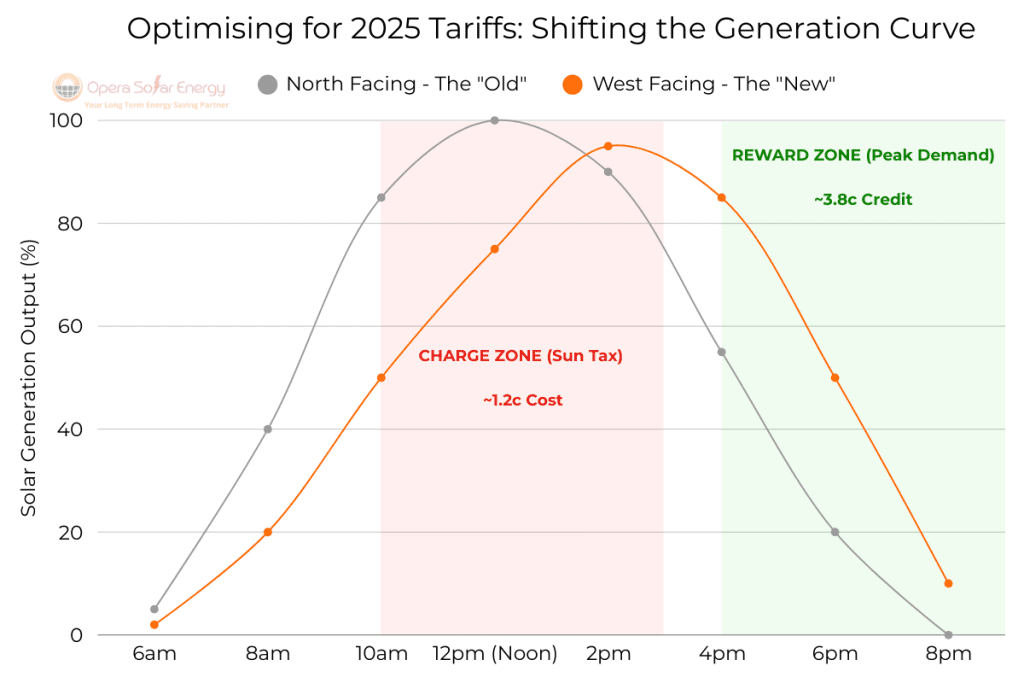
Across Ausgrid and Endeavour networks, two structural shifts now dominate outcomes. The first is two-way pricing, often referred to as the Sun Tax. Midday exports during the solar soak window are either devalued or penalised. The second is voltage rise. In dense commercial suburbs such as Chatswood and Norwest, grid voltage regularly approaches the 258V trip threshold during peak generation.
When those two forces combine, poorly engineered systems do not fail loudly. They clip, throttle, or disconnect intermittently. On paper, the system looks compliant. In practice, yield erodes and financial models drift away from reality.
This is where the gap opens between engineered commercial solar and cheap solar packages.
High-performing Sydney regions
High-performing regional NSW areas
Chatswood
Dural
Norwest
Prestons
Brookvale
Smeaton Grange
Hawkesbury corridor
These areas benefit from large roof space, consistent daytime loads and high grid dependence:
-
Southern Highlands (Bowral, Mittagong, Moss Vale)
-
Berry
-
Mudgee
-
Orange
-
Hunter Valley acreage properties
-
Armidale
-
Tamworth agricultural districts
These regions often achieve strong ROI because load patterns align with daytime solar generation.
Engineering Under Two-Way Pricing, Not Against It
A modern Commercial Solar Sydney system must be designed around consumption behaviour, not just roof area.
In practice, that means understanding how load aligns with the solar soak period. Office buildings, logistics sites, cold storage facilities, and agricultural estates all behave differently under the same tariff rules. Export-heavy systems that once looked attractive can now generate power at the least valuable times of day.
Our design logic focuses on:
- Aligning inverter capacity with real daytime load
- Managing export limits so generation remains usable
- Accounting for voltage behaviour during peak solar hours
- Preserving flexibility for future load shifting or storage
For CFOs, this matters because projected returns are now driven more by self-consumption quality than by raw kilowatt output.
High-performing Sydney regions
High-performing regional NSW areas
Chatswood
Dural
Norwest
Prestons
Brookvale
Smeaton Grange
Hawkesbury corridor
These areas benefit from large roof space, consistent daytime loads and high grid dependence:
-
Southern Highlands (Bowral, Mittagong, Moss Vale)
-
Berry
-
Mudgee
-
Orange
-
Hunter Valley acreage properties
-
Armidale
-
Tamworth agricultural districts
These regions often achieve strong ROI because load patterns align with daytime solar generation.
Sydney Metro Versus Regional NSW, Same Rules, Different Constraints
The regulatory framework across NSW is consistent, but the physical constraints are not.
In Sydney metro areas like Chatswood and Norwest, grid density and solar saturation mean voltage rise is often the dominant constraint. Export limits are tightly enforced, and systems must be designed conservatively to remain stable during peak generation.
In regional NSW locations such as the Hunter Valley and Southern Highlands, export limits still apply, but load characteristics are different. Large sheds, irrigation pumps, wineries, and processing facilities often create meaningful daytime demand that can absorb solar effectively. Three-phase power is common, but infrastructure quality varies significantly from site to site.
In both environments, performance depends on site-specific engineering, not postcode averages.
Commercial System Sizing, Without the Guesswork
Most commercial projects fall into broad capacity tiers, but size alone does not determine success.
Smaller commercial systems often rely almost entirely on self-consumption to remain viable under two-way pricing. Mid-sized systems introduce export management and voltage control challenges. Larger systems demand careful three-phase balancing, structural verification, and future readiness for storage or load shifting.
Rather than selling predefined packages, we assess how each capacity tier behaves under current grid constraints and future regulatory tightening. This avoids the common trap of oversizing for headline numbers that never translate into usable energy.
Structural and Electrical Details That Protect Asset Value
Commercial solar becomes part of the building. Shortcuts taken during design or installation rarely show up immediately, but they surface later as corrosion, roof integrity issues, or insurance complications.
Our engineering assumptions typically include:
- Dead load allowances in the range of 12 to 15 kg per square metre
- Verification of purlin spacing and roof structure before final layout
- Roof-specific mounting strategies for clip-lock and screw-down profiles
- 316 stainless steel fixings to manage galvanic corrosion in coastal and agricultural environments
- Wind loading assessed in accordance with AS/NZS 1170.2
- CSIP Aus compliant inverters with voltage logging and remote monitoring
These details are not upgrades. They are baseline requirements for systems expected to perform over decades.
Sun Tax: Frequently Asked Questions
Does the Sun Tax apply to existing systems?
It generally applies to new systems and upgrades requiring network review.
How do we reduce exposure?
Load shifting, batteries and export limiting strategies reduce midday export.
Why shift arrays west?
It increases output during the reward window.
Will these settings change?
Tariffs are reviewed during AER regulatory cycles, which occur roughly every five years.
The Sun Tax and Its Impact on System Design
Why North Facing Solar No Longer Leads Under Two Way Pricing
North facing arrays maximise midday output, which is the lowest value period. Consequently, these layouts often create surplus energy during chargeable hours.
West facing arrays shift generation to the late afternoon reward window. This improves export value and better aligns electricity production with business operations such as logistics, cold storage, production facilities and rural agribusiness.
Batteries, Load Shifting, and Realistic Expectations
Interest in batteries has increased as export conditions tighten. In some scenarios, shifting energy into higher-value consumption windows can materially improve outcomes. In others, batteries add complexity without improving returns.
We assess storage as part of an integrated system, not as a remedy for poor array design. The value of batteries depends on load shape, operational patterns, and tolerance for system complexity. For some sites, demand management and inverter control deliver better results than storage alone.
Why Cheap Commercial Solar Underperforms Quietly
The most expensive solar systems are often the cheapest ones.
Common failure points we see during audits include chronic voltage trips, unmanaged export throttling, under-engineered mounting systems, and inverter selections that struggle under real grid conditions. These systems still generate power. They simply do not generate the power their financial models assumed.
This is why we start with engineering review, not price comparison.
The Problem: Midday Exports Carry a Cost
Midday exports incur a 1.2c/kWh charge while businesses purchase electricity at 30 to 50c/kWh during the 2pm to 8pm peak period.
The Solution: Time Shift the Energy
A battery stores surplus solar during low value hours and releases it during the evening reward window between 4pm and 9pm.
The Five Cent Swing
Avoiding the Solar Soak charge saves 1.2c/kWh
Exporting during the reward window earns 3.8c/kWh
This creates a five cent value shift per kilowatt-hour.
The advantage increases further when stored energy replaces peak grid imports worth 30 to 50 cents per kilowatt-hour.
The Incentive Stack
Federal: ~$370/kWh
NSW BESS2 VPP: $400–$1,500
These incentives shorten battery payback to approximately five to six years.
Flexible Exports and Compliance
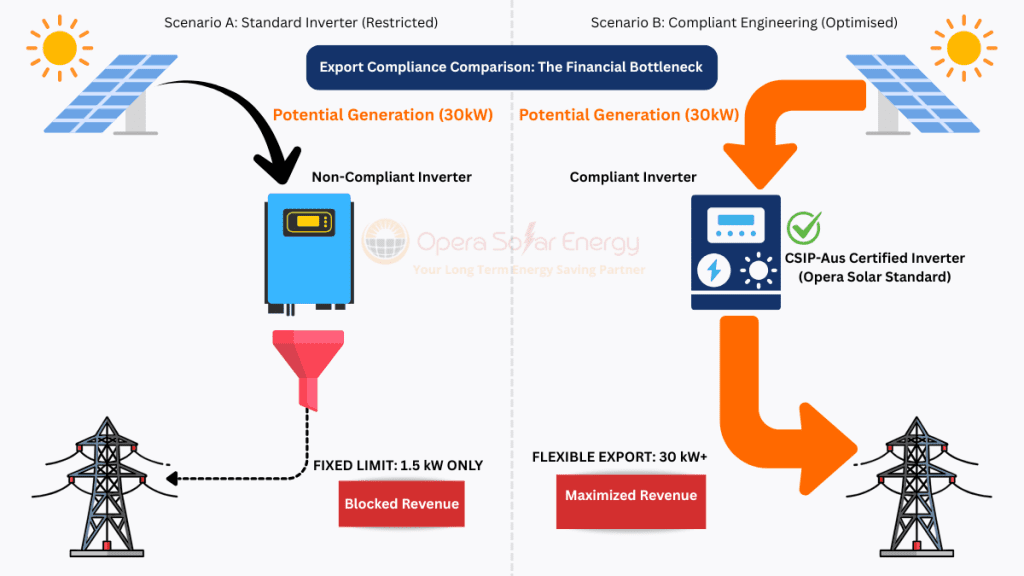
Endeavour Energy requires CSIP Aus certified inverters for flexible exports. Non compliant inverters may be restricted to 1.5 kW, which reduces financial performance.
What an Opera Solar Engineering Review Delivers
An engineering review is not a sales pitch. It is a structured assessment designed to answer three practical questions.
First, how will this system behave under current two-way pricing and export constraints.
Second, where are the voltage and infrastructure risks specific to this site.
Third, does the projected return still make sense once those constraints are applied.
For CFOs, this creates a defensible investment decision. For landowners, it prevents capital being locked into infrastructure that cannot adapt as grid rules evolve.
Commercial Solar That Respects Capital and Complexity
Commercial Solar Sydney projects now succeed or fail on engineering quality, not marketing claims. Systems designed to maximise panel count without regard for voltage, exports, and load behaviour are increasingly exposed.
If you are comparing proposals that look similar on paper but differ wildly in price, the difference is almost always in what has been ignored.
We design systems to behave predictably under real conditions, because that is how serious assets should be treated.
Structural Integrity Requirements
Many commercial and rural buildings constructed before the mid 2000s were not designed for an additional 12 to 15 kilograms per square metre of solar hardware. Insurers review this documentation closely.
Opera Solar’s Structural Audit Protocol
• Purlin spacing verification
• Clip lock and screw fixed roof interface assessment
• Corrosion protection using 316 stainless steel in coastal or salt-affected zones such as Botany, Matraville and Brookvale
These engineering checks protect safety and ensure compliance with insurer and landlord expectations.
Deployment That Respects How Your Site Actually Operates
Commercial solar does not happen on empty buildings. It is installed on sites that are working, trading, producing, and moving people and goods every day. That reality drives how we plan the job.
Our approach is built around a simple principle: the solar installation should adapt to your operations, not interrupt them.
We start with the grid and the building, not the tools.
Before anything turns up on site, we handle the grid connection process with the relevant DNSP, whether that is Ausgrid or Endeavour. At the same time, our engineers assess the roof structure and mounting areas in detail. This work is desk-based and inspection-led, not disruptive. Your team will barely notice it happening.
Nothing arrives on site unchecked.
Every major component is verified off-site before delivery. Fixings, inverter models, voltage capability, and system configuration are confirmed in advance so there are no surprises once work begins. Deliveries are planned and consolidated to minimise site traffic and avoid the frustration of repeated access requests.
Installation is planned around how the building is used.
Work on the roof is broken into defined zones so activity stays contained and predictable. We avoid unnecessary overlap with occupied areas below. If an electrical cut-over is required, it is scheduled outside trading hours or on weekends, depending on how the site operates. The aim is straightforward: your staff and tenants should not have to work around the installation.
Commissioning finishes the job properly.
Once the system is live, we verify voltage behaviour and export settings under real operating conditions. You are then provided with a complete as-built engineering and compliance pack, suitable for asset registers, insurers, and internal governance.
At handover, the system is not just switched on. It is documented, understood, and ready to perform as part of your infrastructure.
Strong adoption segments in 2026 include:
Lifestyle properties and rural estates
Agribusiness operations
Particularly in:
Southern Highlands (Bowral, Mittagong, Moss Vale)
Berry
Mudgee
Orange
Hunter Valley acreage zones
Armidale
Tamworth agricultural districts
These properties operate HVAC, irrigation, pumps, sheds and workshops throughout the day. As a result, they consume a larger share of solar on site, which increases return.
Including:
Poultry facilities
Nurseries and horticulture
Greenhouses
Equine centres
Agricultural pumping
Stable daytime consumption strengthens payback outcomes under the Sun Tax framework.
Voltage Rise: The Hidden Constraint
Several industrial zones around Sydney experience elevated grid voltage. If the grid voltage is already high, the inverter may reach its protection threshold (typically 258 volts) and shut down.
Opera Solar’s Mitigation: We use voltage logging, Volt Var configuration, and tap changing transformers to prevent this production loss.
Why Opera Solar Rejects Low Cost Solar
Low cost solar often excludes structural certification, compliant inverters, corrosion resistant fixings, export modelling and correct electrical testing.
Each omission adds risk, reduces system value and disrupts long term performance.
Opera Solar designs and installs systems that satisfy structural, network, insurer and landlord requirements. This protects ROI and ensures the system operates reliably for years.
Opera Solar’s Structural Audit Protocol
• Purlin spacing verification
• Clip lock and screw fixed roof interface assessment
• Corrosion protection using 316 stainless steel in coastal or salt-affected zones such as Botany, Matraville and Brookvale
These engineering checks protect safety and ensure compliance with insurer and landlord expectations.
Contact and Next Steps
Opera Solar provides:
-
Structural and electrical assessments
-
Tariff and export modelling
-
Flexible export configuration
-
Battery ROI modelling
-
Insurer ready engineering packs
We support commercial operators, agribusiness and lifestyle estates seeking the most reliable commercial solar Sydney services and Regional NSW engineering across:
-
Chatswood, Dural, Norwest, Prestons, Brookvale, Smeaton Grange, Hawkesbury
-
Southern Highlands, Berry, Mudgee, Orange, Hunter Valley, Armidale, Tamworth
Start with an engineering review.
Request Your Preliminary Engineering Review
Our engineers will review your property using satellite data and tariff load profiles to determine your export viability. No cost, no obligation.
We value your privacy. We NEVER Spam.