The Battery Rebate Drops in 2026: Don’t Miss Out on Up to $1,700 in Savings

NSW Home Battery Incentive 2026: The “Double Dip” Guide

The window for maximising solar battery ROI in New South Wales is closing. As of February 2, 2026, we are fewer than 90 days away from a fundamental shift in how the Australian government subsidises residential energy storage. For homeowners across NSW (from the urban corridors of Norwest and Chatswood to the expansive estates of the Southern Highlands) the intersection of Federal policy updates and state-specific incentives has created a unique “Double Dip” opportunity under the NSW Solar Battery Incentive 2026.

This is not a marketing seasonal sale; it is a regulatory sunset. At Opera Solar, our engineering-first approach dictates that we look past the headlines to the raw physics and financial modeling that drive real-world ROI.

The Two Rebates: Federal (STC) vs State (PDRS) Explained

Understanding how incentives work in 2026 requires separating two distinct mechanisms that, for the first time, can be stacked to drive down the upfront cost of a premium battery system. These are often confused as a single “government rebate,” but they are two separate funding pools with different technical requirements.

  1. The Federal “Cheaper Home Batteries Program” (The Hardware Subsidy)

Operated under the Small-scale Renewable Energy Scheme (SRES), this battery rebate program functions through the creation of Small-scale Technology Certificates (STCs). While the industry has utilised STCs for solar panels for over a decade, the 2026 battery expansion is a high-velocity incentive designed to accelerate domestic storage capacity.

The mechanism is simple in theory but rigid in execution: an installer creates certificates based on the expected carbon abatement of the battery over its lifetime. These certificates are then sold to “liable entities” (usually big energy retailers), and the value is passed to you as an upfront discount. In early 2026, this remains the primary driver of affordability, though its value is tied strictly to the date the Certificate of Electrical Compliance (CoC) is signed (not the date you sign your contract).

  1. The NSW Peak Demand Reduction Scheme (The Grid Bonus)

The NSW State Government’s PDRS is a different animal. It is not about how much energy you save, but when you use it. The BESS2 component (Battery Energy Storage System) provides an additional upfront discount for batteries that are “VPP-ready.”

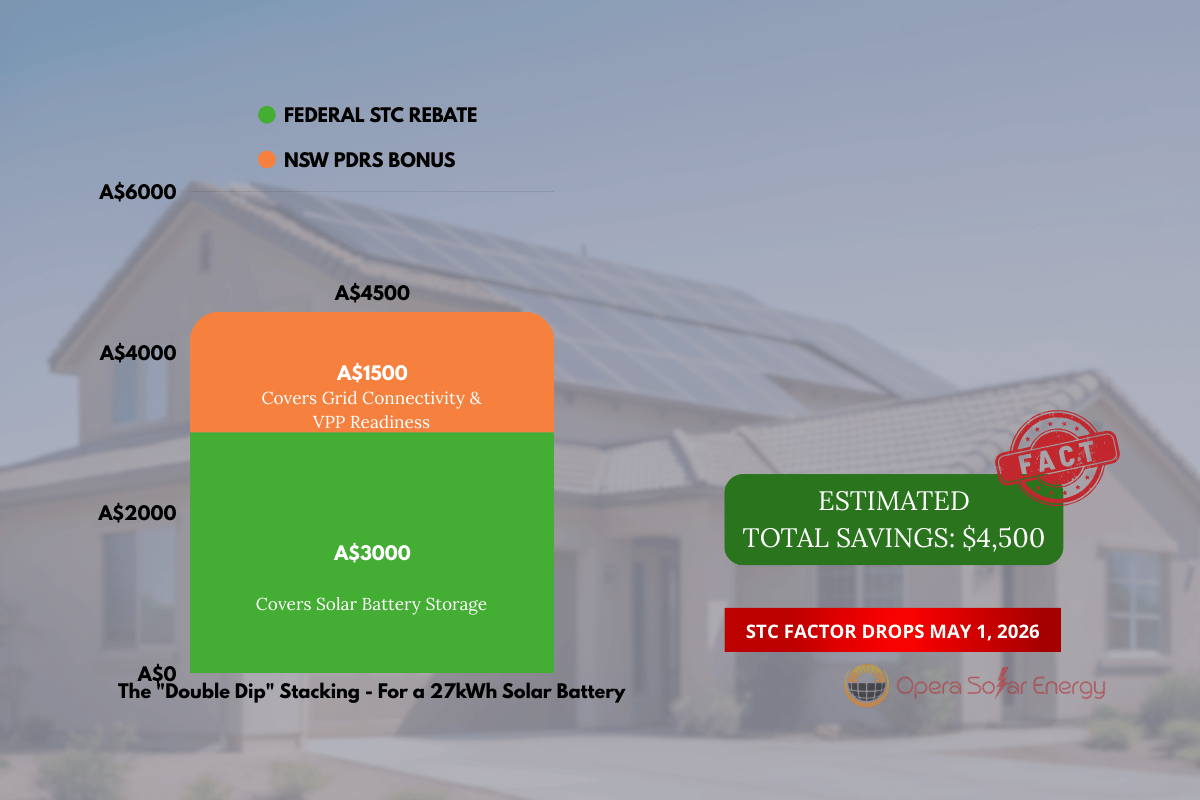
The logic here is a “Double Dip”: The Federal government pays for the physical hardware (the tank), while the NSW government pays for the grid flexibility (the tap). By allowing a Virtual Power Plant (VPP) to occasionally draw from your battery during extreme heatwaves, you receive an additional incentive of up to A$1,500.
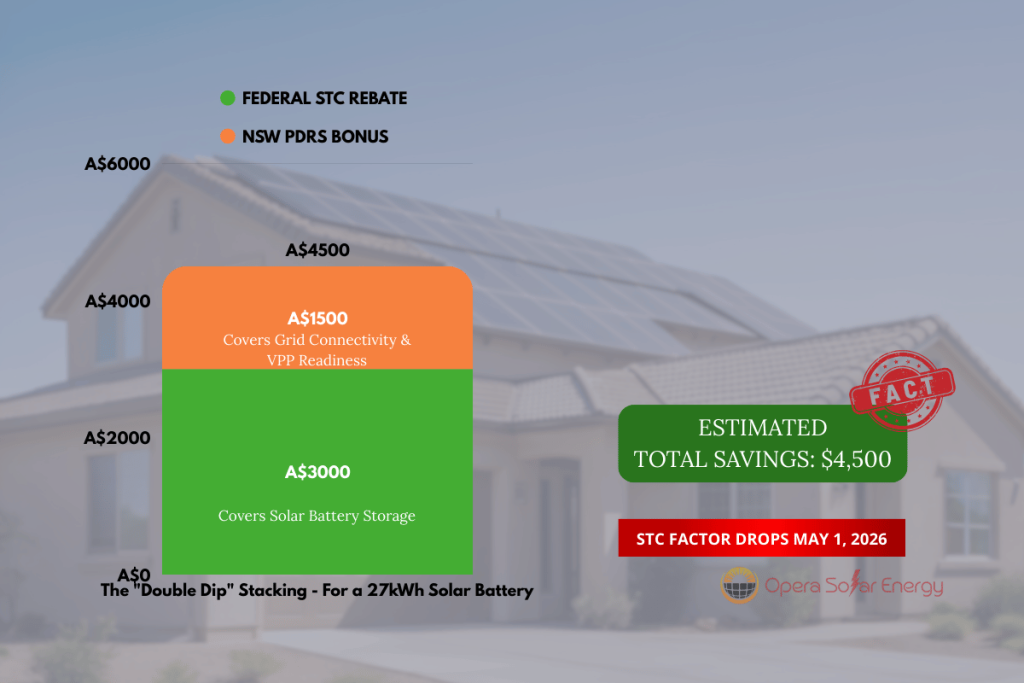
NSW Solar Battery Double Dip Infographic showing combined Federal STC and State PDRS incentives for 2026.

The "May 1st Cliff": The Engineering of a 19% Devaluation

The Federal Government’s expansion of the battery program to $7.2 billion came with a strict mandate: incentives must align with the falling global cost of battery hardware. As LFP (Lithium Iron Phosphate) cell production scales, the subsidy per kWh must naturally decrease to prevent market inflation.

On May 1st, 2026, the STC “factor” is scheduled for a significant reduction. Currently, systems installed and certified before this date utilise an STC factor of 8.4. On May 1st, this factor drops to 6.8.

This is a non-negotiable mathematical cliff. If your electrician finishes the job on April 30th, you receive the 8.4 rate. If a rain delay pushes the final commissioning to May 1st, you lose roughly 19% of the Federal incentive value overnight. For a standard 13.5kWh battery (like the Tesla Powerwall 3), this delay translates to a loss of approximately A$850. For larger systems, the loss is catastrophic.
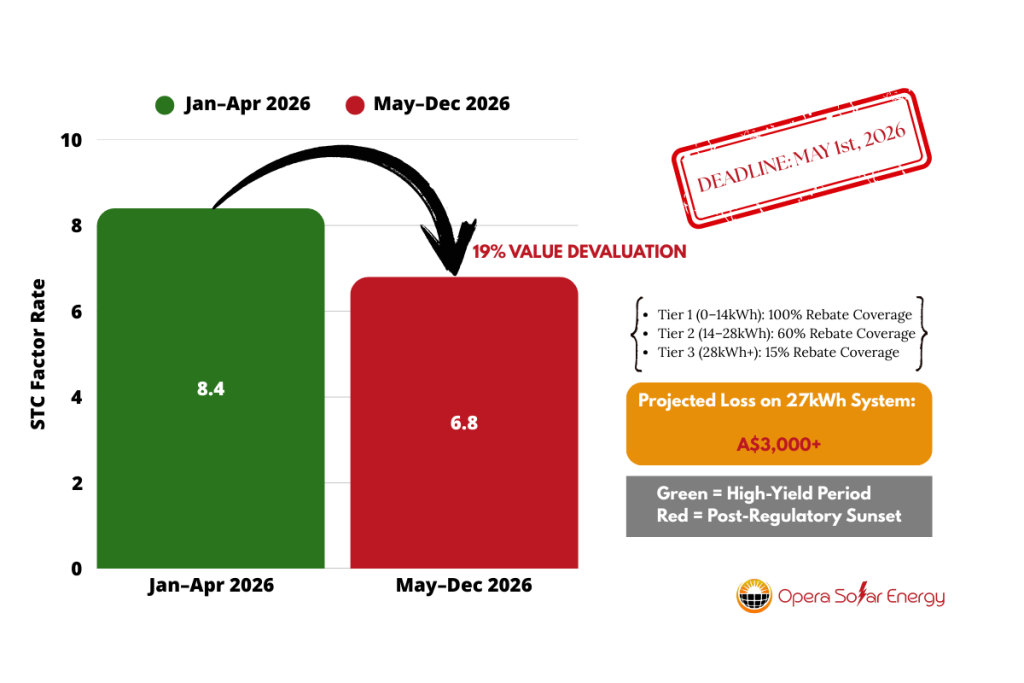
NSW-solar-battery-rebate-2026-stc-drop-chart
The May 1st transition marks the shift from annual to biannual factor reductions, penalising delayed installations.

The Tapering Rule: Why Large Batteries (14kWh+) are Being Targeted

The most significant change coming on May 1st is the introduction of the “Tapering Rule.” In previous years, the rebate was linear (the bigger the battery, the bigger the rebate). From May 2026, the government is now favouring “right-sizing.”

The new STC factor (Post-April 30, 2026) will be applied in tiers based on usable capacity:

  • 0–14 kWh: 100% of the STC factor applies. This covers the vast majority of standard suburban households.
  • 14–28 kWh: Only 60% of the factor applies to the capacity in this bracket.
  • 28–50 kWh: Only 15% of the factor applies to any capacity above 28kWh.

The Engineering Logic Behind Tapering

Why is the government targeting large batteries? From a grid stability perspective, a 13.5kWh battery is sufficient to shift the peak load of an average household. Anything beyond 14kWh is often used for “luxury” backup or high-load off-grid lifestyle choices. By tapering the rebate, the government is trying to make sure the $7.2 billion fund supports more households rather than fewer, larger ones.

If you are building a high-capacity estate in the Hawkesbury or Dural (perhaps requiring 27kWh to 40kWh to handle 3-phase cooling and borehole pumps) your financial window is closing. A 27kWh system faces a projected loss of over A$3,000 if the installation drifts past the April 30th cutoff.

Voltage Rise and the 258V Trip: Why You Need a Battery in 2026

In many parts of NSW, homeowners are discovering a frustrating reality: their solar panels are turning off in the middle of the day. This is caused by Voltage Rise.

When thousands of homes in a suburb (like Norwest or Kellyville) try to push solar energy back into the grid simultaneously, the local grid voltage rises. When it hits the Australian Standard limit of 258V, your inverter is legally required to disconnect to protect the grid.

How a Battery Solves the Technical Bottleneck

A battery acts as a pressure relief valve. Instead of trying to force energy into a grid that is already at 258V, the smart inverter diverts that energy into the battery.

  1. Direct Self-Consumption: You store the energy you would have lost.
  2. Peak Shaving: You use that energy at 6:00 PM when grid prices are at their highest.

NSW PDRS Compliance: By having this storage, you qualify for the state “Double Dip” because you are technically helping the grid manager handle local voltage issues.

The NSW PDRS: How to Unlock the Extra A$1,500 State Bonus

While the Federal STC handles the hardware, the NSW PDRS targets the “intelligence” of the system. To claim the PDRS BESS2 incentive, the battery must meet very strict technical criteria that many cheap solar imports simply do not meet.

The Technical Requirements for PDRS

  • Usable Capacity: Must be between 2kWh and 28kWh.
  • Warranty: Must have a minimum 10-year warranty with at least 70% capacity retention.
  • VPP Readiness: The system must be internet-connectable and capable of responding to remote signals.
  • Energy Throughput: If installed after April 1, 2026, the battery must have a warranted cumulative energy throughput equivalent to 3.65 MWh per kWh of capacity.

This throughput requirement is a major hurdle. It effectively bans low-quality batteries that degrade quickly. At Opera Solar, we only specify hardware (such as the Tesla Powerwall 3, SigEnergy, ESY-Sunhome, or GoodWe) that exceeds these rigorous standards.

The VPP Requirement: Addressing the Control Concern

To access the NSW State bonus, VPP participation is mandatory. For many regional landowners and high-net-worth urban homeowners, the idea of a third party controlling their battery is a non-starter. However, it’s important to understand how VPPs actually work today.

How a VPP Actually Works in 2026

You are not giving up control of your battery. You are joining a coordinated network.

  • Algorithmic Trading:
    • The ‘High Risk/High Reward’ Model (e.g., Amber): When the grid price spikes (e.g., to $19.00/kWh), their software (SmartShift) dumps your battery power into the grid and pays you that high rate directly.
    • The ‘Fixed Bonus’ Model (e.g., Origin Loop): When the grid is stressed, they discharge your battery (maximum up to 200 kWh per year) to help, but they pay you a fixed ‘Event Credit’ (typically $1.00/kWh), regardless of how high the market price goes.
  • Opt-Out Freedom: Most modern VPP contracts allow you to retain a Backup Reserve. You can tell the system to never let your battery drop below 30%, ensuring you always have power for a blackout.

No Lock-ins: You can often claim the upfront PDRS discount and then choose your energy provider freely after a 12-month period.

Regional NSW: Special Considerations for Estates and Agriculture

For our clients in the Southern Highlands, Hunter Valley, and Hawkesbury, battery engineering is not just about saving $50 on a bill; it is about operational resilience.

3-Phase Loads and Machinery

Most regional properties operate on 3-phase power. Installing a single-phase battery (like older generation units) on a 3-phase home creates “Phase Imbalance.” If your battery is on Phase A and your air conditioning is on Phase B, you will still be buying power from the grid while your battery sits full.

We prioritise True 3-Phase Inverters (like the SigEnergy SigenStor) for these properties. These systems can balance loads across all three phases simultaneously, ensuring that every watt of stored energy is used on-site before a single cent is paid to the retailer.
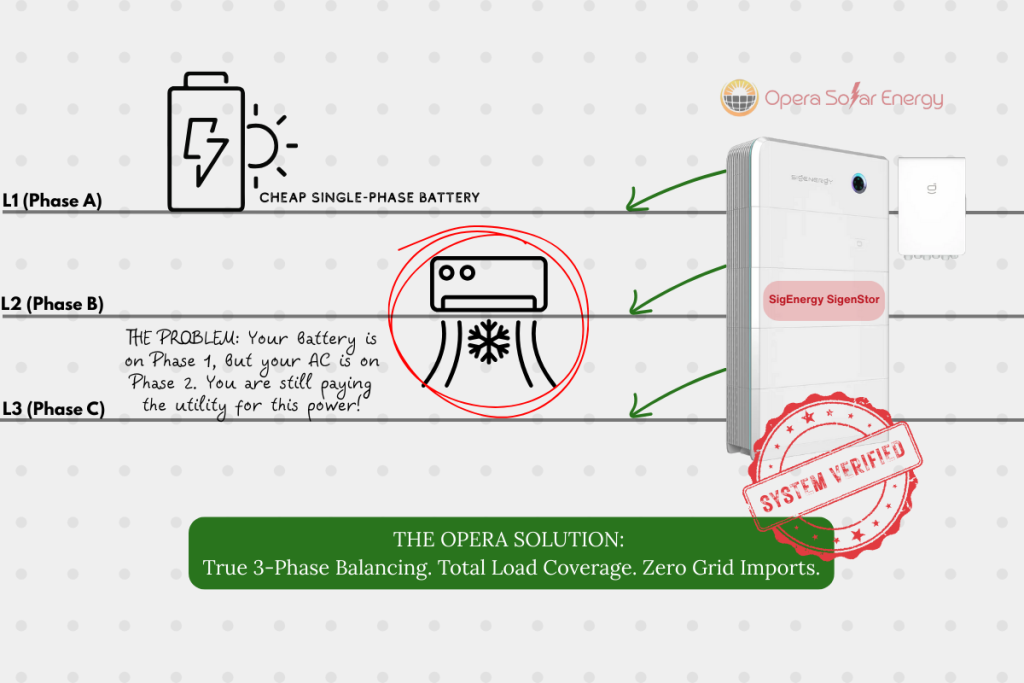
Technical 3-phase electricity diagram showing phase imbalance with single-phase batteries versus 3-phase hybrid solar storage
Why single-phase batteries fail on 3-phase NSW estates: Visualizing phase imbalance and the True 3-Phase solution.

Fire Season and Blackout Resilience

In regional NSW, the grid is often “skinny” and prone to outages during storm seasons or bushfire events. The Tesla Powerwall 3, with its max 11.5kW continuous output (on-grid), is uniquely suited for these environments. It can sustain the high “in-rush” current required to start large borehole pumps or industrial refrigeration units that smaller, cheaper batteries would simply trip on.

Top 3 Battery Picks for 2026: The Engineering Breakdown

1. Tesla Powerwall 3 (The High-Output Specialist)

The Powerwall 3 is a DC-coupled hybrid system. By eliminating the need for a separate solar inverter, it reduces conversion losses (the DC-AC-DC tax).

  • Best For: Homes with high-surge appliances (AC, Pumps, EV Chargers).
  • NSW Bonus: Fully compliant with PDRS and all major VPPs.
  • The Catch: It is a fixed size (13.5kWh). If you need 15kWh, you have to buy two.

2. SigEnergy SigenStor (The AI-Integrated Multi-Tool)

SigEnergy has revolutionised the stackable battery market. It integrates the inverter, battery, and even an EV DC charger into a single aesthetic tower.

  • Best For: New builds in Norwest/Chatswood and tech-forward homeowners.
  • Engineering Edge: It is one of the only residential batteries that offers native DC-to-DC EV charging, bypassing the efficiency losses of standard AC chargers.
  • NSW Bonus: Its AI software is designed specifically for VPP optimization.

3. Sungrow SBR HV (The Modular Workhorse)

Sungrow is the global leader in inverter technology, and their SBR battery series is a favorite for those who want flexibility.

  • Best For: Growing families who may want to add more capacity in 2 years.
  • Engineering Edge: High-voltage LFP chemistry allows for incredibly fast charge and discharge rates without overheating.

NSW Bonus: Extremely competitive pricing makes the “Double Dip” ROI even faster.
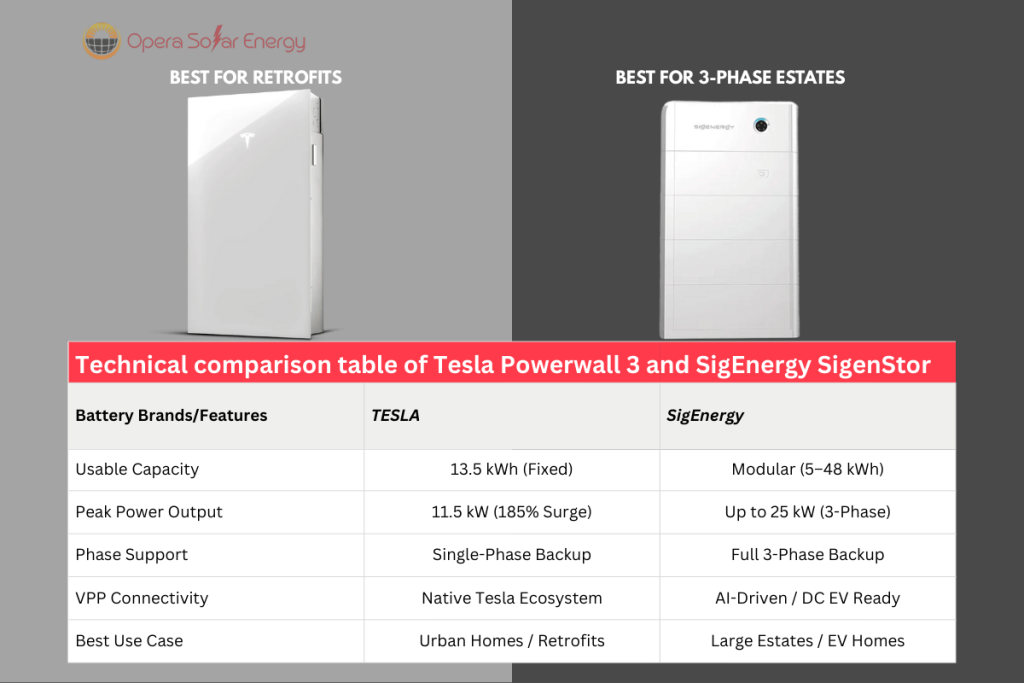
Technical comparison table of Tesla Powerwall 3 and SigEnergy SigenStor solar batteries for NSW homes in 2026.
Tesla Powerwall 3 vs. SigEnergy SigenStor: Comparing all-in-one simplicity against modular 3-phase flexibility.

The Financial Model: The "Procrastination Tax" in Dollars

Let’s look at the hard numbers for a high-usage home in NSW requiring a 27kWh storage solution (e.g., a dual-Powerwall or large SigEnergy stack).

Metric

Scenario A: April 2026 Install

Scenario B: May 2026 Install

STC Factor

8.4 (Full Rate)

6.8 (Reduced Rate)

Tapering Applied?

No

Yes (Loss on capacity >14kWh)

Federal Rebate Value

A$8,845

A$5,781

NSW PDRS Bonus

A$1,500

A$1,500

Total Incentive

A$10,345

A$7,281

Net Cost Difference

$0

A$3,064

By delaying the project by a single day (from April 30 to May 1), the homeowner effectively pays A$3,064 tax. When you factor in the lost energy savings during those months of delay, the gap widens further.

The 4-Week Paperwork Buffer: Why March, not April is the Deadline

The most dangerous assumption a homeowner can make is that a “quote” protects their rebate. The Clean Energy Regulator and the NSW Energy Savings Scheme dictate that the rebate is determined by the Installation Date (specifically the date the CoC is signed and the serial numbers are registered).

The Regulatory Bottlenecks

  1. DNSP Approval (21 Days): Ausgrid and Endeavour Energy can take up to three weeks to approve a battery connection, especially for larger 3-phase systems.
  2. Structural Assessment: For regional shed mounts or older urban roofs, an engineering sign-off on the physical weight of the battery is often required.
  3. Supply Chain Squeeze: As the May 1st deadline approaches, national stock of high-demand units like the Powerwall 3 and SigEnergy SigenStor will inevitably tighten. Stock usually runs out 3-4 weeks before a major rebate drop.

To lock in the 8.4 STC factor and the maximum Double Dip bonus, the engineering review phase must begin either by the end of February or early March.

Comprehensive 2026 NSW Solar Battery FAQ

Can I claim the Federal battery rebate if I already have solar panels?

Absolutely. The program is designed for both new solar-plus-battery installations and retrofits. In fact, retrofitting a battery to an older solar system is one of the most effective ways to modernise your home’s energy profile (which is exactly why we track these regulations daily). The only technical requirement is that the battery must be between 5kWh and 100kWh and installed by a SAA-accredited professional.

No. Unlike previous means-tested rebates, the current NSW PDRS and the Federal STC program are available to all NSW homeowners and small businesses. The goal is grid stability, and a wealthy household’s battery stabilises the local network just as effectively as any other.

The NSW PDRS originally had two parts. BESS1 was an installation discount that was suspended in 2025 to avoid doubling up with the Federal program. BESS2 is the current incentive specifically for connecting to a VPP. This is the bonus you receive for the “Double Dip.”

This is the critical risk. If your final certification is signed on May 1st, you lose the 8.4 STC factor and are subject to the Tapering Rule. This is why Opera Solar implements a safety buffer for all our Q1 installations, aiming for completion at least 7 days before the deadline to account for weather or supply delays.

Off-grid properties are eligible for the Federal STC program, but they are not eligible for the NSW PDRS bonus. This is because the PDRS is funded based on Peak Demand Reduction for the public grid. If you aren’t connected to the grid, you aren’t reducing its demand.

Not always. AC-Coupled batteries like the Tesla Powerwall 3 can be added to almost any existing solar system. However, DC-Coupled systems (like SigEnergy or Sungrow) often perform better if you are installing solar at the same time or if your current inverter is more than 7-8 years old.

If installed after 1 May 2026, the first 14kWh of your 30kWh battery receives the full rebate. The next 14kWh (taking you to 28kWh) receives only 60% of the rebate. The final 2kWh (taking you to 30kWh) receives only 15% of the rebate. In total, you would lose roughly 40% of the potential rebate compared to an April installation.

Yes, provided you choose a quality hardware brand. Modern LFP batteries are designed for 6,000+ cycles. A VPP might only call on your battery 20-30 times a year. This represents less than 0.5% of the battery’s total life expectancy, making the impact on wear and tear negligible compared to the massive upfront financial bonus.

Round-trip efficiency is the amount of energy you get back out of the battery compared to what you put in. Premium systems like the Tesla Powerwall 3 have a round-trip efficiency of approximately 90%. Cheaper, generic batteries can be as low as 80%, meaning you lose 20% of your solar power just by storing it.

Yes. The incentives are property-linked, not individual-linked. If you have a primary residence in Norwest and a holiday estate in the Southern Highlands, you can claim the Double Dip on both, provided each property has its own NMI (National Meter Identifier) and meets the technical criteria.

5 1 vote
Article Rating
Subscribe
Notify of
guest
0 Comments
Oldest
Newest Most Voted
Inline Feedbacks
View all comments
0
Would love your thoughts, please comment.x
()
x
Are you ready to go solar?
Get a Quick Quote!
Get Solar with Maximum Rebate
Keep me informed as we work toward Australia’s Net Zero 2050 goal.
Are you ready to go solar?
Get a Quick Quote!
Get Solar with Maximum Rebate
Keep me informed as we work toward Australia’s Net Zero 2050 goal.
The Battery Rebate Drops on 1 May 2026: Don’t Miss Out on Up to A$16,400 in Savings
Get Rebate
The Battery Rebate Drops on 1 May 2026: Don’t Miss Out on Up to A$16,400 in Savings
Get Rebate