The Battery Rebate Drops in 2026: Don’t Miss Out on Up to $1,700 in Savings

ESY Sunhome Battery Review: What is the ESY Sunhome HM6 Battery System?

The ESY Sunhome HM6 is a premium single phase hybrid inverter 6kW platform paired with high capacity stackable solar battery modules. Designed for heavy energy users and small business sites, the system scales smoothly from a 5.12 kWh baseline up to a massive 30.72 kWh in a single vertical footprint. 

The ESY Sunhome battery price in Australia ranges from $12,000 to $20,000 (for a 15 kWh to 30 kWh battery) depending on your total module count. It is engineered with an IP66 outdoor solar battery rating, integrated per module fire extinguishers, and blackout backup power with a precise 20 ms transition. This robust engineering makes it one of the top 10 solar batteries Australia currently offers for pure reliability.

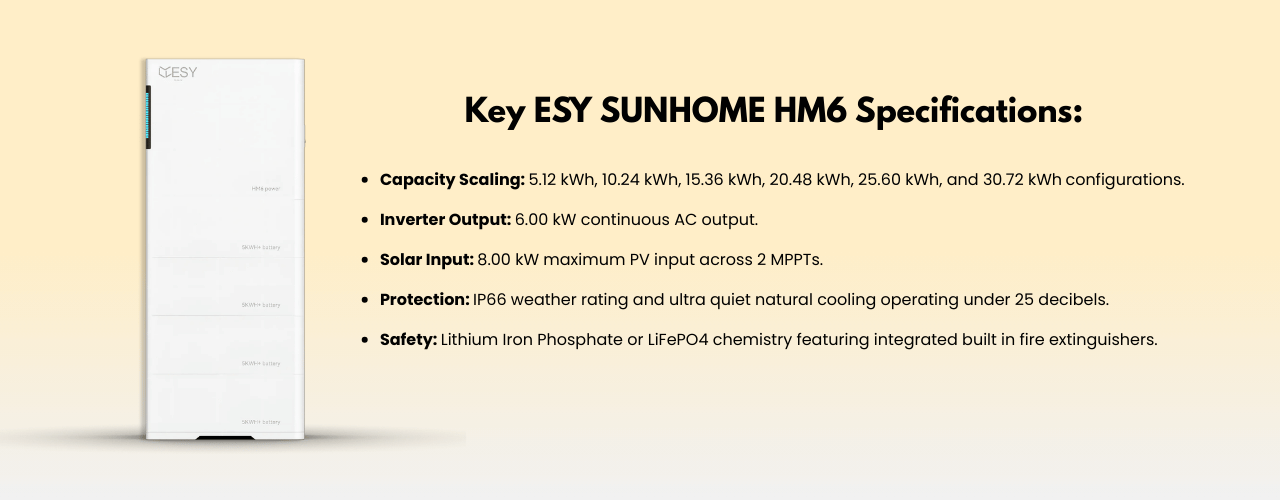
Key ESY Sunhome HM6 Specifications:

  • Capacity Scaling: 5.12 kWh, 10.24 kWh, 15.36 kWh, 20.48 kWh, 25.60 kWh, and 30.72 kWh configurations.
  • Inverter Output: 6.00 kW continuous AC output.
  • Solar Input: 8.00 kW maximum PV input across 2 MPPTs.
  • Protection: IP66 weather rating and ultra quiet natural cooling operating under 25 decibels.
  • Safety: Lithium Iron Phosphate or LiFePO4 chemistry featuring integrated built in fire extinguishers.

For owners of power-hungry homes and small businesses, the energy storage conversation in 2026 has completely shifted. It is no longer just about basic solar self-consumption. It is a serious infrastructure investment. With grid tariffs climbing higher every single year, anyone searching for an honest ESY Sunhome Battery Review already knows the truth. Deploying a high capacity solar storage single phase system has become a highly strategic asset for managing your daily running costs.

We are going to evaluate the ESY Sunhome HM6 Battery Review. This is a true all-in-one residential solar energy storage system that pairs a moderate 6kW hybrid inverter with heavy-duty stackable battery modules. The setup is designed specifically for properties that need massive energy reserves but only require a standard 6kW continuous output. You can scale it up rapidly from a baseline 5.12 kWh right through to a towering 30.72 kWh. If you are sitting down and analysing your Residential Solar ROI Sydney, this specific configuration puts forward a highly compelling financial case. There is a catch though. You only lock in those top-tier returns if the system is fully commissioned before the looming federal rebate tapering deadlines hit the market hard on May 1st, 2026.

The Engineering Platform: ESY Sunhome HM6 Battery Specifications

When you sit down to evaluate the best 30kWh solar battery solutions on the market, the inverter is always the operational heart of the asset. The ESY Sunhome battery system runs on their proprietary HM6 platform. This is a dedicated single phase hybrid inverter 6kW unit. It is crucial to understand the engineering distinction here. While the battery storage capacity is massive at 30.72 kWh, the inverter output is a moderate 6kW. It is specifically engineered to shoulder your moderate to heavy, consistent base loads all day long without suffering from thermal throttling, rather than attempting to run a heavy industrial factory floor.
ESY Sunhome Battery Review - ESY Sunhome HM6 Battery
ESY Sunhome Battery Review – ESY Sunhome HM6 Battery Significant Features

Inverter Capability and Solar Harvesting

Let’s look at the solar harvesting grunt. The HM6 inverter can handle up to 8.00 kW of direct solar panel input right off the roof. It splits this power across two separate tracking channels. You will find some brands pushing three or four trackers for complicated roof layouts. But if you have a massive unobstructed commercial shed or a simple ground-mounted array out on a regional block, those two channels are exactly what you need. They keep the engineering simple and the conversion highly efficient. The inverter takes that raw DC solar energy and feeds it straight into your battery stack. At the exact same time, it pushes a solid 6.00 kW of continuous AC power straight down to your switchboard.

Let’s break down what that 6.00 kW output actually means for a high usage household solar design or a light commercial site. It provides a rock-solid energy baseline. It is not built to run a heavy industrial workshop. Instead, it is engineered to comfortably shoulder your daily circuits without tripping. If you run a small business, 6.00 kW is plenty to keep your critical server racks, point-of-sale registers, and standard office lighting online smoothly. At home, the reality is very much the same. You can comfortably run a couple of split-system air conditioners, the big kitchen fridge, the pool pump, and the television all at once. Better yet, you still have just enough headroom left in the tank for those brief power spikes when someone flicks on the kettle or fires up the microwave.

Capacity Scaling: The Stackable Architecture

The absolute defining feature of the ESY Sunhome ecosystem is its vertical scalability. The system utilizes stackable solar battery modules that each pack a nominal capacity of 5.12 kWh. Because lithium chemistry always requires a protective buffer so you do not degrade the cells prematurely, the usable capacity per module is electronically governed down to 4.86 kWh. This pure modularity lets a business or homeowner tailor their upfront capital expenditure exactly to their overnight consumption profile. You are not forced to buy a massive box if you do not need it yet.

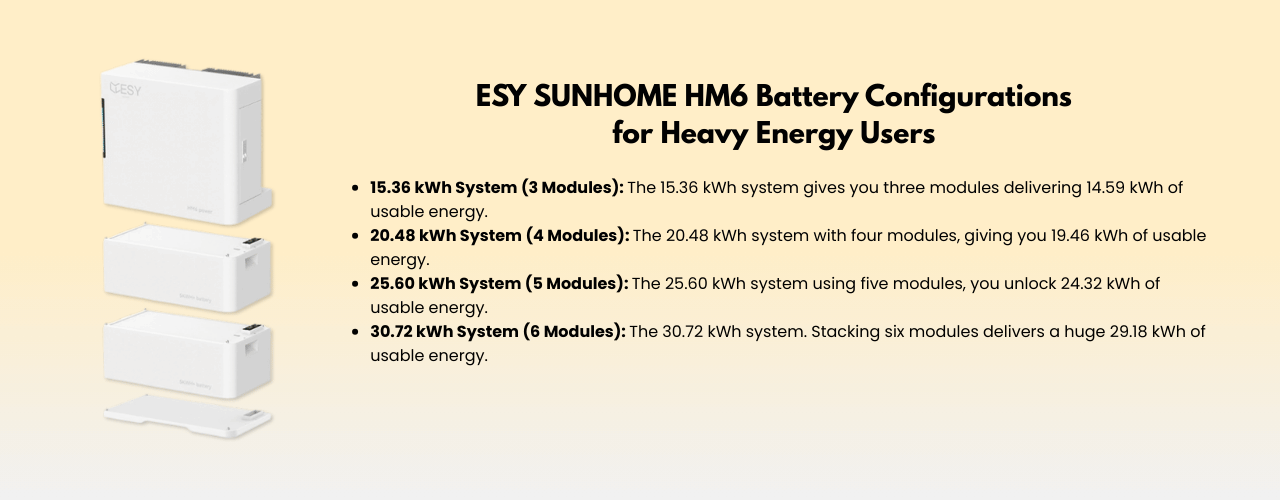
ESY Sunhome HM6 available configurations for Heavy Energy Users:
ESY Sunhome Battery Review - ESY Sunhome Battery Stackable Modules and 6kW Inverter
ESY Sunhome Battery Review – ESY Sunhome Battery Stackable Modules and 6kW Inverter
  • 15.36 kWh System (3 Modules): Stepping up to the 15.36 kWh system gives you three modules delivering 14.59 kWh of usable energy. This is an ideal starting point for large residential properties managing heavy evening peaks. 
  • 20.48 kWh System (4 Modules): Then there is the 20.48 kWh system with four modules, giving you 19.46 kWh usable. This is rapidly becoming the standard baseline for a 20kWh solar storage system if you want to replace significant overnight grid reliance.
  • 25.60 kWh System (5 Modules): If you jump to the 25.60 kWh system using five modules, you unlock 24.32 kWh of usable energy. This setup sits perfectly in the 25kWh home battery market, specifically for households managing heavy electric vehicle charging demands overnight. 
  • 30.72 kWh System (6 Modules): Finally, there is the massive 30.72 kWh system. Stacking six modules delivers a huge 29.18 kWh of usable energy. This is the ultimate commercial battery storage installation for achieving near-total grid independence on a single-phase connection.

This “build exactly what you need” approach ensures that your initial ESY Sunhome battery price aligns tightly with current operational budgets. Crucially, it leaves plenty of room for simple future expansion if your site loads increase down the track.
Financial Analysis: Residential Solar ROI Sydney

Purchasing a massive 30.72 kWh storage system is a serious capital allocation for any household. The financial justification rests on three solid pillars. You are looking at peak tariff arbitrage, overnight electric vehicle charging offsets, and capturing a highly lucrative tier of the solar battery federal rebate 2026. While the absolute maximum federal subsidy technically caps out closer to the 50kWh mark, a 30.72 kWh stack still pulls down an enormous upfront discount under the current STC multiplier.

Peak Tariff Arbitrage and Evening Load Shielding

Let us talk about peak tariff arbitrage first. For high usage households across Sydney, electricity bills are structured around punishing Time of Use tariffs. The evening peak rate between 4 PM and 9 PM is a massive financial drain on family budgets. By programming the ESY Sunhome HM6 to discharge heavily during those incredibly expensive evening hours, the system physically shields your home from the peak grid draw. You can run the ducted air conditioning, cook dinner, and wash clothes entirely from your stored daytime solar. This level of solar self consumption optimization can strip thousands of dollars right off your annual household expenses.

The May 1st STC Factor Tapering Deadline

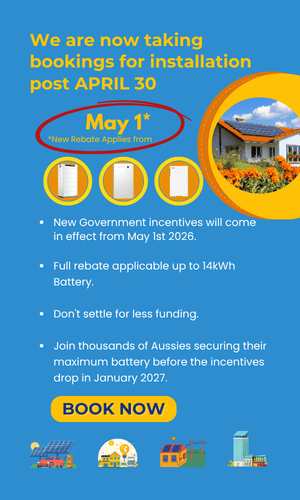
Then we have the impending May 1st tapering deadline. Right now, the most critical factor in calculating your Residential Solar ROI Sydney is the federal rebate mechanism. Under the current scheme, we utilise an STC deeming period multiplier of 8.4. With STCs currently trading at approximately $39 each, you get a substantial upfront discount on large capacity batteries.

But a recent strict legislative change has hit the residential market hard, and it will come in effect on May 1, 2026. The baseline multiplier drops sharply from 8.4 down to 6.8 (a massive 19% decline). More importantly, a harsh new capacity tapering rule is introduced. This new rule explicitly penalises large storage clusters. Any system capacity you install over the 14kWh threshold will see its STC incentive aggressively reduced by 40 to 85 percent per additional kilowatt hour.

If you are sitting there evaluating a 15kWh solar battery price or pricing up the massive 30.72 kWh stack for your estate, delaying your installation past April 30 will literally cost your family thousands of dollars in lost subsidies. The ROI model degrades extremely fast once that tapering penalty applies to your upper 16 kWh of storage. Immediate procurement is the only real strategy left to secure the current high yield rebate.

Site Readiness: The 2278mm Clearance Rule

Moving from financial modelling to physical deployment changes the conversation completely. The ESY Sunhome HM6 system imposes strict spatial requirements. A full 30.72 kWh solar battery stack is a massive column of dense lithium. It requires appropriate operational clearance to function safely.

To accommodate the maximum six module configuration, the physical stack reaches a substantial 1878 mm in height. Strict lithium battery safety guidelines in Australia, alongside the manufacturer’s thermal specifications, mandate a top ventilation clearance of at least 400 mm. This mandatory gap ensures heat dissipates efficiently away from the natural cooling system on the inverter head unit.

The Vertical Space Calculation

When you combine the 1878 mm physical height of the unit with that minimum 400 mm top ventilation gap, the total minimum ceiling height required for installation hits 2278 mm. Strict lithium battery safety guidelines in Australia, alongside the manufacturer’s thermal specifications, mandate this top ventilation clearance. This mandatory gap ensures heat dissipates efficiently away from the natural cooling system on the inverter head unit.

Horizontal Clearances and AS/NZS 5139 Compliance

Vertical height is only half the engineering equation. You must also account for frontal operational access and strict fire safety egress pathways. The standard front clearance requirement for the ESY Sunhome battery system is a flat 600 mm. This allows a technician enough room to safely access the wiring and isolation switches.

However, Australian installation standards dictate a much stricter reality for internal thoroughfares. In accordance with AS/NZS 5139, if you install this system inside a corridor, hallway, or lobby, the frontal clearance must stretch to at least one clear metre. This strict one metre rule ensures completely safe egress for occupants in the event of a severe emergency. When you combine the physical depth of the battery unit with a mandatory one metre walkway, installing this asset inside a narrow residential hallway becomes instantly non compliant. You must factor this footprint into your site planning from day one.

Industrial Durability: IP66 and LFP Safety Protocols

When you install a high value asset outside, environmental protection becomes absolutely paramount. The ESY Sunhome HM6 is rated as a true IP66 outdoor solar battery.

Weather and Thermal Management

This IP66 rating means the main cabinet is completely dust tight and heavily protected against powerful jets of water. It is explicitly built to withstand the highly corrosive coastal salt air found across Sydney’s eastern suburbs or the extreme dust common in regional agricultural hubs. Furthermore, the system relies entirely on highly efficient natural cooling. Because it does not require loud internal mechanical fans for standard operation, the unit generates an incredibly low operational noise level of under 25 decibels. This makes the system virtually silent. You can comfortably install it near office windows or residential living areas without causing any acoustic fatigue.

LFP Solar Battery Safety and Fire Suppression

The core chemistry inside these modules is Lithium Iron Phosphate or LiFePO4. In 2026, this remains the undisputed industry standard for LFP solar battery safety. It offers unmatched thermal stability compared to older legacy battery cells.

ESY Sunhome elevates this baseline safety standard by integrating hardware protection directly into the modules. As specified by the manufacturer, each 5.12 kWh module includes a built-in fire extinguisher system. In the highly unlikely event of a severe thermal anomaly within a specific cell block, this integrated system is designed to mitigate the threat at the source before it can spread to the rest of the 30.72 kWh stack. While installation must always comply with AS/NZS 5139, this per module suppression architecture may assist with certain commercial risk assessments depending on your specific insurer requirements.

Business Continuity: 20ms Blackout Backup Power

The best battery for heavy energy users must do more than store cheap solar power. It must protect the site against grid failure. Sydney’s grid infrastructure faces increasing instability during summer peak load events.

The ESY Sunhome HM6 platform includes an integrated automatic transfer switch. When the grid drops, the system provides blackout backup power with a precise 20 ms switching time. This transition is fast enough to ensure desktop computers do not reboot and sensitive point of sale server systems do not crash.

Crucially, the inverter is engineered to handle heavy startup spikes. While it delivers 6000 W of continuous power , it features an impressive overload capacity capable of handling a 120% surge for 30 seconds. For a household or commercial operator, this means the inverter has the brute strength to absorb the intense power draw of heavy water pumps or refrigeration compressors starting up during a blackout, keeping your essential load circuits energized without tripping the system.

Competitor Showdown: The High Capacity Market

To understand the true value of the ESY Sunhome HM6 price in Australia, we must benchmark it directly against the other leading industrial storage brands operating in the 2026 landscape.

ESY Sunhome HM6 vs GoodWe ESA Series

The GoodWe ESA Series is a dominant force in the high capacity market. It offers a monolithic all in one cabinet that scales up to 48 kWh.

The Inverter Difference: The GoodWe ESA utilizes a massive 10kW single phase inverter. The ESY Sunhome runs a very targeted 6kW inverter. If your site requires massive instantaneous power to start heavy single phase workshop machinery or massive ducted air conditioners, the GoodWe has a clear edge in sheer brute force.

The Footprint Difference: The ESY Sunhome is truly modular. You can easily click modules together to build exactly 20.48 kWh or 25.60 kWh without wasting an inch of space. The GoodWe ESA requires a much larger and heavier floor cabinet from day one, regardless of how many individual battery modules you actually slide into it. ESY Sunhome provides far better granular control over your initial capital layout and physical floor space.

ESY Sunhome Battery vs Fox ESS Battery

Fox ESS provides highly respected high voltage tower systems that dominate the heavy residential sector.

Voltage Architecture: Fox ESS utilizes a true high voltage architecture that frequently exceeds 400V. This is highly efficient for transferring large amounts of power very quickly. By contrast, the ESY Sunhome operates on a 51.2V battery architecture. This is the highly stable, established standard for low voltage residential energy storage systems. It safely manages the energy at this lower voltage before stepping it up at the inverter head. 

Safety and Environment: While both are clearly excellent systems, the IP66 rating on the ESY Sunhome is measurably more robust against severe water ingress than the standard IP65 ratings found on most Fox ESS battery towers. Furthermore, the integrated fire extinguisher in every ESY module provides a distinct feature set for indoor installations where clients are highly focused on supplementary safety mechanisms.

Choosing among these top solar battery brands in Australia depends entirely on your specific site loads and physical constraints. If you need purely modular, ultra safe storage with completely silent operation and a rock solid 6kW continuous output, the ESY Sunhome remains the most strategic choice on the market today.

Summary: Is the ESY Sunhome Right for Your Property?

The ESY Sunhome HM6 platform represents a heavily engineered solution for anyone demanding high capacity solar storage single phase integration. It scales smoothly from a 15.36 kWh starting point for large residential properties right up to a massive 30.72 kWh peak limit.

By combining proven LFP safety, IP66 weather durability, and a precise 20 ms blackout backup transition, this system physically secures your site against sudden grid outages and constantly escalating retail tariffs.

However, the financial viability of this specific investment remains highly time sensitive. Homeowners and small business operators must finalize their procurement before the strict May 1st, 2026 STC tapering deadline hits the market. Failing to act before the new over 14kWh penalty is officially enforced will drastically reduce your Residential Solar ROI Sydney.

Frequently Asked Questions: Fox ESS Battery Review

Can I install the ESY Sunhome 30.72 kWh system in direct sunlight?

While the ESY Sunhome HM6 is an IP66 outdoor solar battery built for severe weather, no lithium battery should ever be placed in direct unshaded Australian sunlight. Direct solar radiation rapidly increases the internal ambient temperature. According to the manufacturer specifications, while the unit can survive up to 60 degrees Celsius, the system actively begins thermal derating and slows down power output once temperatures exceed 45 degrees Celsius. To guarantee maximum performance and longevity, we strictly mandate a shaded south facing wall or the construction of a protective awning for all outdoor installations.

The ESY Sunhome modular architecture operates on an advanced low voltage parallel management system. If one 5.12 kWh module registers a critical internal fault, the master Battery Management System isolates that specific module electronically. The rest of the stack continues to operate normally at a slightly reduced total capacity. You will receive an immediate system alert on your app, and a technician can swap out the single defective module without needing to replace the entire tower.

As the standard manufacturer documentation does not explicitly detail a native hardwired dry contact for a two wire generator auto start, we take a conservative engineering approach. If your regional property requires indefinite off grid autonomy relying on a heavy diesel backup generator, we recommend installing a compatible third party automatic transfer switch and smart relay system external to the ESY Sunhome cabinet to properly manage the generator integration.

As specified by ESY Sunhome engineering documentation, each individual 5.12 kWh battery module features a built-in fire extinguisher. In the highly unlikely event that a module experiences a critical thermal event, this localized system is designed to deploy internally to neutralize the chemical fire at the source. This targeted approach aims to prevent an isolated fault from compromising the adjacent battery modules stacked above or below it.

It is an absolute mandatory compliance requirement. The ESY Sunhome HM6 inverter relies entirely on natural cooling to maintain its zero noise profile. It dissipates heat directly out of the top of the unit. If you restrict that required 400 mm vertical ventilation gap, the heat physically cannot escape. The inverter will rapidly overheat, derate its power output, and eventually shut down completely. Violating this spatial clearance instantly voids your manufacturer warranty.

No, you absolutely cannot. Under the strict eligibility rules of the federal Cheaper Home Batteries Program, adding capacity to an existing system is only eligible for a discount if the original battery has not already received support under the program. If you install a 15.36 kWh stack now and claim your subsidy, any future battery modules you add to that system down the track will be completely ineligible for further STC financial support. Because you only get one opportunity to subsidise this specific system, it is far more financially efficient to purchase the full 30.72 kWh configuration upfront on your initial claim.

No it cannot. The ESY Sunhome HM6 is strictly a single phase hybrid inverter platform. It cannot output a rotating 3 phase waveform. If you have a massive 3 phase commercial air conditioning unit, you cannot run it directly from this specific battery during a blackout. To back up heavy 3 phase machinery, you must explore true 3 phase commercial platforms like the GoodWe ET series or a massive Fox ESS 3 phase configuration. The ESY Sunhome is designed exclusively to back up large heavy single phase loads across dedicated essential circuits.

Disclaimer: All engineering and financial figures are estimates for modelling purposes only. Final yield is subject to site inspection and DNSP approval.

Are you ready to go solar?
Get a Quick Quote!
Get Solar with Maximum Rebate
Keep me informed as we work toward Australia’s Net Zero 2050 goal.
Are you ready to go solar?
Get a Quick Quote!
Get Solar with Maximum Rebate
Keep me informed as we work toward Australia’s Net Zero 2050 goal.
The Battery Rebate Drops on 1 May 2026: Don’t Miss Out on Up to A$16,400 in Savings
Get Rebate
The Battery Rebate Drops on 1 May 2026: Don’t Miss Out on Up to A$16,400 in Savings
Get Rebate