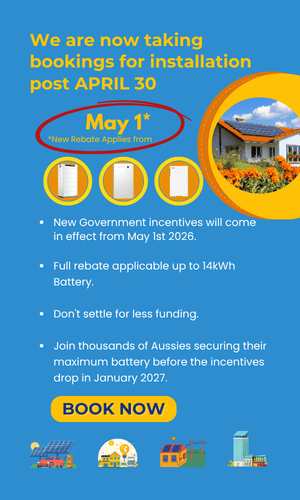
Quick Update on the April 30 Battery Rebate:
Thanks to massive local demand, the Opera Solar team is fully booked for the rest of April. This means any new battery orders will be installed from May onwards, and will fall under the new rebate rates starting May 1.
While the maximum April rebate has passed, the May rebate is still a great way to save on your battery. Please reach out today to secure your spot in our May schedule before those dates book out too.
What is the Fox ESS EQ4800 Battery?
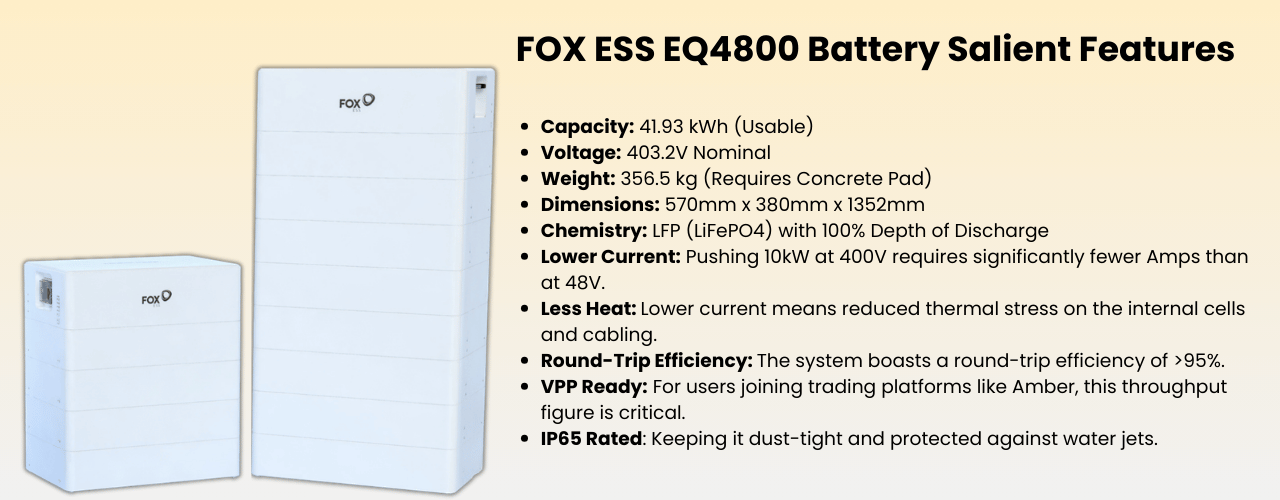
The Fox ESS EQ4800 is a High Voltage (HV) modular battery system designed for residential and light commercial energy storage. The “L9” configuration stacks nine modules to achieve a massive 41.93kWh capacity in a single, compact tower. Operating at ~403V, it offers higher efficiency than legacy 48V systems and is rated IP65 for outdoor installation. It is a “value engineering” solution, offering industrial-grade storage density at a price point significantly lower than premium lifestyle brands.
Key Specifications:
- Capacity: 41.93 kWh (Usable)
- Voltage: 403.2V Nominal
- Weight: 356.5 kg (Requires Concrete Pad)
- Dimensions: 570mm x 380mm x 1352mm
- Chemistry: LFP (LiFePO4) with 100% Depth of Discharge
In the 2026 solar battery storage landscape, most homeowners are sold “appliances”—sleek, white boxes that look nice on a garage wall but struggle to run a real estate. The Fox ESS EQ4800 is different. It is not an appliance; it is infrastructure.
For the regional landowner in the Hunter Valley or the heavy-use residence in Dural, the Fox ESS Battery Review conversation shifts from “aesthetic appeal” to “raw industrial capacity.” This is a High Voltage (HV) tower that packs 41.93kWh of usable energy into a footprint smaller than a standard refrigerator.
While Tesla and Sigenergy fight for the “lifestyle” market, Fox ESS has quietly built the “Commercial Workhorse”, a 400-volt behemoth designed to run large properties without the “brand tax.”
The Engineering of the “L9” Stack
The specific configuration we are reviewing is the EQ4800-L9. This is the maximum density tower, comprising one Master Module (EQ4800-M) and eight Slave Modules (EQ4800-S).
Industrial Density:
Most competitors require two or three separate towers to reach 40kWh. Fox ESS achieves 41.93kWh in a single vertical stack.
- Dimensions: 570mm (W) x 380mm (D) x 1352mm (H).
- The Benefit: You get massive capacity without losing your entire garage wall. However, gravity is a factor; this single tower weighs 356.5kg. It cannot be installed on a timber floor; it demands a reinforced concrete plinth.
High Voltage Logic: 400V Efficiency
The “EQ” series is a true High Voltage (HV) system. Unlike legacy 48V batteries that push massive current (Amps) to move power, the EQ4800-L9 operates at a nominal 403.2 Volts.
From an engineering perspective, this is superior for large-scale storage:
- Lower Current: Pushing 10kW at 400V requires significantly fewer Amps than at 48V.
- Less Heat: Lower current means reduced thermal stress on the internal cells and cabling.
- Round-Trip Efficiency: The system boasts a round-trip efficiency of >95%, ensuring that the massive amount of solar you harvest actually makes it back into your home, rather than being lost as waste heat.
In its L9 configuration, the EQ4800 delivers 20.16kW nominal discharge power, allowing it to support high-load scenarios when paired with an appropriately rated hybrid inverter.
42kWh Battery System Price: The Rebate Sweet Spot
Financial modelling for 2026 highlights the Fox ESS EQ4800-L9 as a strategic asset. The Federal “Cheaper Home Batteries” Program caps out at 50kWh. By installing a 41.93kWh system, you are capturing the absolute maximum tier of the subsidy without crossing into the complex “Commercial Class B” regulatory environment.
The May 1st Deadline
The rebate value is currently calculated on an STC deeming period that drops significantly on May 1st, 2026.
- Current Estimated Rebate: ~$13,600 – $13,800 (Based on 41.93kWh capacity at $39/STC).
The Urgency: Waiting until winter to install this infrastructure could see this rebate value drop by approximately 19%. For a system of this size, that is a four-figure loss in upfront capital support.
Installation Realities: Not for Timber Floors
We need to be blunt about the physical requirements of this system. The 356.5kg weight means this is a civil engineering exercise as much as an electrical one.
Site Readiness Checklist:
- Concrete Pad: Essential. The point-loading of this tower exceeds the structural rating of most suspended timber floors found in older Queenslanders or NSW cottages.
- Clearances: While the unit is compact, it requires airflow. The IP65 rating allows for outdoor installation, but we strongly recommend a shaded position (South Wall or Garage) to keep the battery within its specified operating range (0°C to 55°C for charging, and -10°C to 55°C for discharging), as defined in the manufacturer’s datasheet.
Three-Phase Ready: The High Voltage architecture pairs natively with Fox ESS three-phase hybrid inverters, making it the ideal retrofit for large homes with 3-phase air conditioning and workshop machinery.
Safety & Compliance: The 356kg Question
The Fox ESS’ company brochure says “Easy Installation,” but the datasheet says 356.5kg. To put that in perspective, this battery tower weighs as much as a grand piano concentrated into a footprint the size of a doormat (0.21 m²).
- Floor Loading: This exerts a pressure of roughly 1,600kg per square meter. A standard Australian timber deck is rated for ~200kg/m². Installing this on a timber floor is not just non-compliant; it is structurally dangerous.
- Thermal Derating: While the unit is rated to operate up to 55°C, real-world data shows the BMS begins to “derate” (slow down) charging above 45°C to protect the cells. In Western Sydney or regional NSW, a West-facing brick wall can easily exceed 50°C in summer.
- The Opera Solar Protocol: We mandate a Southern Aspect or Shaded Garage installation for all EQ4800 units. If an outdoor install is the only option, we may require a dedicated awning to prevent direct solar gain from triggering thermal throttles.
Real-World Performance Validation: The "Amber" Factor
One of the most frequent questions we field in 2026 is: “Does Fox ESS actually work with wholesale trading apps like Amber?“ The answer is yes, but it requires specific configuration.
Unlike Sigenergy’s native AI, Fox ESS relies on cloud API integration for VPPs. In early deployments, some users reported issues where third-party control algorithms would accidentally set the battery’s “Max Discharge Current” to 0A, effectively freezing the system.
- The Fix: We now configure the FoxCloud 2.0/3.0 app with specific “Safety Buffers” that prevent external VPP software from overriding critical BMS limits.
The Experience: Once tuned, the high-voltage architecture is exceptionally responsive to price spikes. Because the system operates at high voltage (~403V), it can deliver high discharge power with lower current stress compared to 48V systems, contributing to stable response during rapid load changes.
The "Retrofit" Reality Check
Many homeowners look at the EQ4800 as a way to add 40kWh to an existing solar system. While possible, “AC Coupling” this beast is often a mistake.
- The Bottle-Neck: If you pair this 42kWh tower with a standard AC-coupled inverter (like the Fox AC1 series), your charge/discharge rate is often limited to the inverter’s AC capacity (typically 5-6kW).
- The Result: It would take over 7 hours to fully charge or discharge the battery.
The Engineering Solution: For a battery of this size, we almost always recommend a “DC-Coupled Retrofit.” We replace your existing string inverter with a Fox ESS H3 Pro (15-30kW). This allows you to charge the battery at significantly higher speeds (up to 30kW depending on the model) directly from the solar panels, bypassing the AC conversion bottleneck entirely.
The Warranty Reality: Understanding "Throughput"
A standard ’10-year warranty’ can be vague. Fox ESS offers precision. Like a car warranty that covers ’10 years or 160,000km’, industrial batteries are covered for time or ‘Energy Throughput’ (Total MWh cycled).
Why this is good for you:
- Transparency: You know exactly how hard you can drive the system.
- VPP Ready: For users joining trading platforms like Amber, this throughput figure is critical.
- Our Protocol: To ensure you get the maximum coverage, Opera Solar automates the warranty registration process during commissioning, locking in your full term from Day 1.
The manufacturer specifies a cycle life of ≥6000 cycles at 25°C and 90% depth of discharge, with 70% state of health remaining at end of life. This aligns with modern Tier-1 LFP expectations for high-capacity residential storage.
Software Experience: Data Over Design
In 2026, the app is your dashboard. The FoxCloud 2.0 platform takes a different approach to its lifestyle competitors. Where others prioritise smooth animations and minimalism, FoxCloud prioritises data granularity.
The Engineer’s Choice:
- Deep Visibility: See cell-level voltages, real-time grid Hz, and exact power flows—data that ‘lifestyle’ apps often hide to keep things simple.
- Utilitarian Design: It is built to be a tool, not a toy. If you want to set and forget, it works perfectly in the background. If you want to analyse every watt, it gives you the raw numbers.
- VPP Integration: For advanced trading, we often recommend third-party controllers (like Amber SmartShift) which bypass the native app entirely to unlock AI-driven profits.
Comparison: Fox ESS vs. The Market Leaders
When evaluating the Fox ESS Battery Price, it is critical to compare it against the correct tier of competitors.
Feature | Fox ESS EQ4800 (L9) | Tesla Powerwall 3 (x3) | Sigenergy SigenStor |
Capacity | 41.93 kWh | 40.5 kWh (13.5 x 3) | 48 kWh |
Voltage | ~403 V (HV) | AC-Coupled | High Voltage |
Footprint | Single Tower (Small) | 3 x Wall Units (Large) | Single Tower |
Weight | 356.5 kg | ~390 kg (Combined) | ~400kg+ |
IP Rating | IP65 | IP67 | IP66 |
Chemistry | LFP | LFP | LFP |
Price Tier | Value Leader | Premium | Premium |
The Verdict: If you want a “status symbol” with a slick app, buy Tesla. If you want maximum kWh per dollar and a system that acts as a dedicated power plant for a large property, Fox ESS can deliver a lower cost per installed kilowatt-hour in high-capacity configurations compared to stacking multiple smaller-format batteries.
The High-Voltage Showdown: Fox ESS vs. Sigenergy
In the 2026 market, Sigenergy has captured the “AI & Software” narrative, while Fox ESS has quietly secured the “Industrial Capacity” ground. Both systems operate on a similar High Voltage (HV) architecture, which is a significant step up from legacy 48V batteries, but they serve different masters.
The “Brain” vs. The “Brawn”
- Sigenergy (SigenStor): Is undeniably the “smarter” system. Its integrated GPT-4o AI and native DC-coupled EV charger make it a lifestyle product for the tech-obsessed. It predicts weather, trades aggressively on the spot market, and talks to you via an app.
- Fox ESS (EQ4800): Is the “stronger” silent partner. It lacks the conversational AI and the integrated EV charger of the SigenStor. However, it counters with brute-force engineering. The EQ4800-L9 tower offers 41.93kWh of storage in a footprint that is physically smaller and simpler to install than an equivalent SigenStor stack.
The 5-in-1 Difference Sigenergy’s “5-in-1” module (Inverter, Battery, EV Charger, BMS, EMS) is brilliant for reducing wall clutter. Fox ESS takes a more traditional “Modular” approach.
- The Fox Advantage: By keeping the inverter (e.g., H3 Pro) separate from the battery tower, Fox ESS allows for massive flexibility. You can install a 30kW inverter with a 42kWh battery—a ratio that is harder to achieve with SigenStor’s pre-packaged stack limits. For commercial farms or large estates where the solar array is huge (30kW+) but the battery needs are specific, Fox ESS often provides a more tailored “lego set” than Sigenergy’s all-in-one tower.
The Brand Battle: Fox ESS vs. Tesla Powerwall 3
In the 2026 marketplace, Tesla is the “iPhone” of batteries—polished, user-friendly, and ubiquitous. Fox ESS, by contrast, is the “Server Rack”—utilitarian, expandable, and built for heavy lifting.
The “Appliance” vs. “Infrastructure” Divide
- Tesla Powerwall 3: Is an AC-coupled “Appliance.” It is designed to look beautiful on a garage wall. However, its capacity is fixed at 13.5kWh. To reach the ~40kWh capacity of the Fox ESS tower, you would need to install three separate Powerwall units.
- The Cost: This triples your installation complexity (three units, three mounts, more cabling) and significantly increases the price per kWh.
- The Limitation: The Powerwall 3 is a single-phase device. While it can be installed on 3-phase properties, it cannot natively provide true 3-phase backup (powering a 3-phase lift or pump) without complex stacking.
- Fox ESS EQ4800: Is “Infrastructure.” It offers 41.93kWh in a single vertical column.
The 3-Phase Advantage: “The 3-Phase Advantage: When paired with a compatible Fox ESS H3 Pro three-phase hybrid inverter, the system can provide native 3-phase backup capability. This allows properly configured installations to support 400V workshop machinery, 3-phase air conditioning, and bore pumps during a grid outage.
The Reliability Battle: Fox ESS vs. Sungrow
Sungrow is one of the prominent players in the Australian solar market. Their SBH Series batteries are legendary for reliability. Positioning Fox ESS alongside Sungrow isn’t about claiming “better,” but rather “equivalent capability for a smarter price.”
The “Stack” Architecture Both brands use a similar “Stackable Brick” design, where battery modules click on top of each other without external wiring.
- Sungrow SBH: Uses huge capacity modules (3.2kWh or higher depending on the series), typically maxing out at 25.6kWh per tower. To reach ~42kWh, you need two separate towers and a combiner box. This doubles the floor space required in your garage.
- Fox ESS EQ4800: Is designed for Vertical Density. The L9 configuration stacks up to 41.93kWh in a single tower. For a homeowner with limited floor space but high energy needs (e.g., a skinny garage in a terrace house), Fox ESS offers nearly double the energy density per square metre of floor space compared to a standard Sungrow setup.
Grid Forming & Backup Both systems offer excellent backup. Sungrow’s backup is robust and widely trusted by installers. Fox ESS matches this with UPS-grade switching when paired with the H3 Pro series.
The “At Par” Reality: In 2026, the difference in hardware quality between a Tier 1 Sungrow unit and a Tier 1 Fox ESS unit is negligible. The cells are often from similar top-tier chemistries (LFP). The difference lies in the packaging: Sungrow sells on “Brand Trust,” while Fox ESS sells on “System Density.” If you need 40kWh+ in a single column, Fox ESS wins the geometry war, even if Sungrow wins the popularity contest.
The Architecture Battle: Fox ESS vs. GoodWe ESA Series
For the buyer looking at “All-in-One” solutions, the GoodWe ESA Series is the closest engineering rival to the Fox ESS tower. Both target the high-capacity market, but their assembly philosophy is different.
“Lego Tower” (Fox) vs. “Server Cabinet” (GoodWe)
- Fox ESS (EQ4800): Uses a “Stackable Brick” architecture. The installer builds the tower module-by-module (Master + 8 Slaves) on a plinth.
- Pros: Flexible height. If you only need 30kWh today, you stop at 6 modules. You can add more later (within a short window).
- Cons: External DC cabling is minimal but still exists between the inverter and the tower.
- GoodWe ESA Series: Uses a “Monolithic Cabinet” architecture. It is a pre-wired fridge-sized unit where modules slide into a rack.
- The Capacity Edge: The GoodWe ESA creates a single 50kWh unit (49.92kWh), whereas the Fox ESS tower maxes out at ~42kWh (41.93kWh).
- The Compliance Edge: The GoodWe ESA inverter is rated at 9.999kVA, ensuring it slips under the “Level 2” engineering review threshold in NSW networks. Fox ESS inverters in this class (H3 Pro) are often rated at 15kW+, which triggers a more complex and expensive grid approval process.
The Verdict: If you need Native 3-Phase Power for heavy machinery and want the absolute lowest cost per kWh, Fox ESS is the winner. If you want the Maximum Rebate (hitting the 50kWh cap) and a “pre-wired” cabinet that looks cleaner in a garage, the GoodWe ESA takes the crown.
Frequently Asked Questions: Fox ESS Battery Review
How heavy is the Fox ESS 42kWh battery?
The full EQ4800-L9 stack weighs 356.5kg. This is extremely heavy for a footprint of just 0.2 square meters. It cannot be installed on a standard timber floor or deck. It requires a reinforced concrete slab or a structural ground-mount plinth to ensure safety and stability.
Is Fox ESS better than Tesla Powerwall?
For “Value Engineering,” yes. To get 42kWh of storage with Tesla, you would need to buy three separate Powerwall 3 units, which costs significantly more in both hardware and installation labor. Fox ESS offers similar capacity in a single tower for a lower cost per kWh, although it lacks the polished software ecosystem of Tesla.
Can I install the Fox ESS battery outside?
Yes, the unit is rated IP65, which means it is dust-tight and protected against water jets. However, like all batteries, direct sunlight will degrade performance over time. We recommend installing it on a shaded South-facing wall or under a dedicated awning to ensure the 10-year warranty conditions are met.
Why is "High Voltage" important?
The EQ4800 operates at over 400 Volts DC. This matches the voltage of your solar panels more closely, reducing the work the inverter has to do to convert power. High Voltage systems run cooler and are generally more efficient than older 48V battery systems, making them better suited for large-capacity cycling.
Does the Federal Rebate cover this battery?
Yes. The 41.93kWh capacity is under the 50kWh cap for the Federal “Cheaper Home Batteries” rebate. Until May 1st, 2026, this system makes you eligible for a massive subsidy (estimated around $13,600+), making it one of the most rebate-efficient purchases on the market.
Disclaimer: All engineering and financial figures are estimates for modelling purposes only. Final yield is subject to site inspection and DNSP approval.