Key Insights: The Sigenergy Advantage
For Australian households in 2026, the Sigenergy SigenStor has moved beyond being just a battery. It is now the country’s premier “5-in-1” energy ecosystem. Unlike the Tesla Powerwall 3 or Sungrow SBR, which are primarily storage units, the SigenStor integrates a hybrid inverter, DC EV charger, and GPT-4o enabled energy trading into a single, vertically stackable tower. Why it is the 2026 Market Leader:- Massive Scalability: Scales from a modest 16kWh up to a commercial-grade 48kWh without using extra floor space.
- 0ms UPS Protection: Delivers medical-grade backup power, ensuring servers and sensitive appliances never flicker during a blackout.
- Native DC EV Charging: Charges your EV directly from rooftop solar, bypassing the inefficiencies of standard AC wall chargers, delivering 15% more solar energy directly to your EV compared to standard wall chargers.
- True 3-Phase Asymmetry: Unlike standard inverters, SigenStor can direct 100% of its power to a single heavy phase (like a kitchen or workshop) to prevent grid usage during unbalanced loads.
- Maximum Financial Return: A fully stacked system qualifies for up to $15,724 in Federal Rebates—but you must install before the May 1st, 2026 cut-off to avoid the 19% drop.
The Australian energy market has shifted from simple solar generation to complex asset management. In this environment, the Sigenergy SigenStor price Australia represents more than just a battery purchase; it is a capital investment into a “5-in-1” energy hub. While the Tesla Powerwall 3 remains a capable consumer-grade product, the SigenStor addresses the specific engineering requirements of high-demand Australian households by integrating a hybrid inverter, battery PCS, EV DC charger, BMS, and an AI-driven EMS into a single vertical stack.
By consolidating these components, Sigenergy eliminates the redundant AC/DC conversion cycles that plague traditional installations. In practice, this means your solar energy remains in DC form from the roof, through the battery, and directly into your vehicle. For early adopters and EV owners in 2026, this structural efficiency is the difference between a system that merely saves money and one that actively generates a superior internal rate of return (IRR).
The Smart Engineering of the 5-in-1 Stack
The SigenStor’s primary advantage is its modular, vertical architecture. Traditional systems often require extensive wall space and complex external wiring to expand capacity. Sigenergy uses a pin-to-pin connection system that eliminates external cables between modules. This design not only improves aesthetic appeal in high-end Norwest or Chatswood garages but also significantly reduces the risk of electrical faults at the connection points.
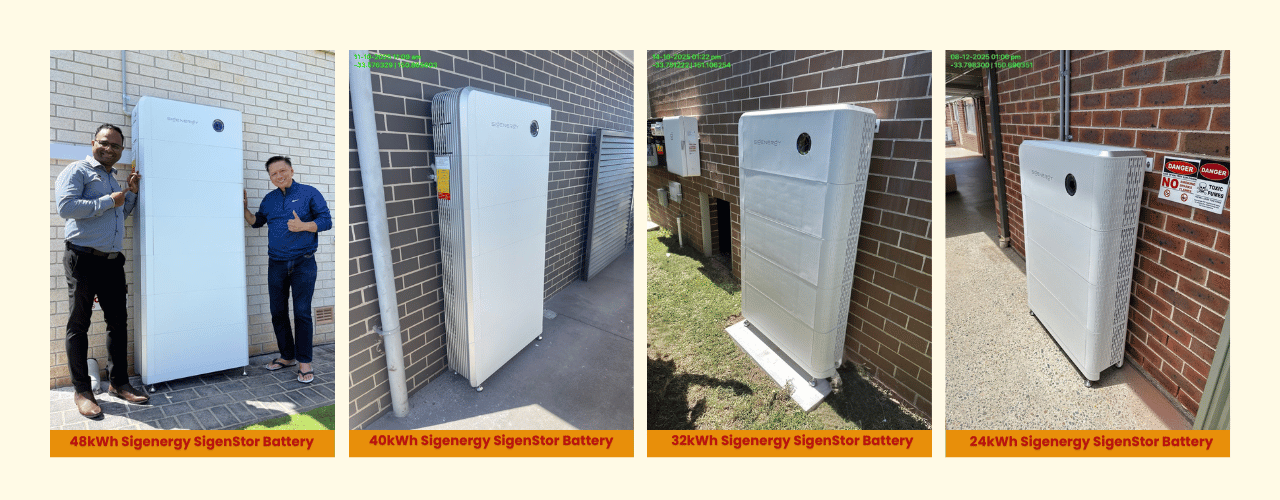
A base configuration typically starts at 16kWh, utilizing two 8kWh modules. However, the system’s true potential is realized as it scales toward a 48kWh tower. Because the footprint remains identical regardless of height (700mm wide by 260mm deep), homeowners can achieve massive storage density without sacrificing floor space.
48kWh Battery System Price: Maximising the 2026 Rebate
Financial engineering is as critical as electrical engineering when evaluating the SigenStor. As of early 2026, the Federal “Cheaper Home Batteries” Program remains the most aggressive incentive for storage in Australian history. However, the window for maximum subsidisation is closing fast.
The rebate operates on a “Deeming Period” logic. Currently, until April 30, 2026, the STC factor is set at 8.4. On May 1st, 2026, this factor is scheduled to drop by roughly 19% to 6.8 (based on the proposed adjustment from the Clean Energy Regulator). For those considering a large-scale 48kWh stack, this timing is the difference of thousands of dollars in upfront capital.
Detailed Pricing Breakdown (2026 Estimates)
In the 2026 Sydney market, a typical SigenStor installation follows this price logic:
Component | Estimated Price (AUD) | Engineering Note |
Energy Controller (5kW – 30kW) | $3,500 – $9,000 | The “Brain” (Hybrid Inverter + EMS) |
8kWh Battery Module (LFP) | ~$4,500 per mod | 100% Depth of Discharge |
EV DC Charging Module (12.5kW/25kW) | +$5,500 – $7,500 | DC-to-DC efficiency, bypasses AC losses |
Energy Gateway (Backup) | +$2,990 | Required for 0ms UPS-grade backup |
For a complete 48kWh battery system price, the hardware and installation typically range between $40,000 and $46,000 before the federal rebate. Once the ~$15,724 rebate is applied, the net cost for a massive 48kWh utility-grade system sits around $25,000 to $30,000, making it one of the most cost-effective “large format” residential systems in Australia.
Rebate Tiers and the "Sweet Spot"
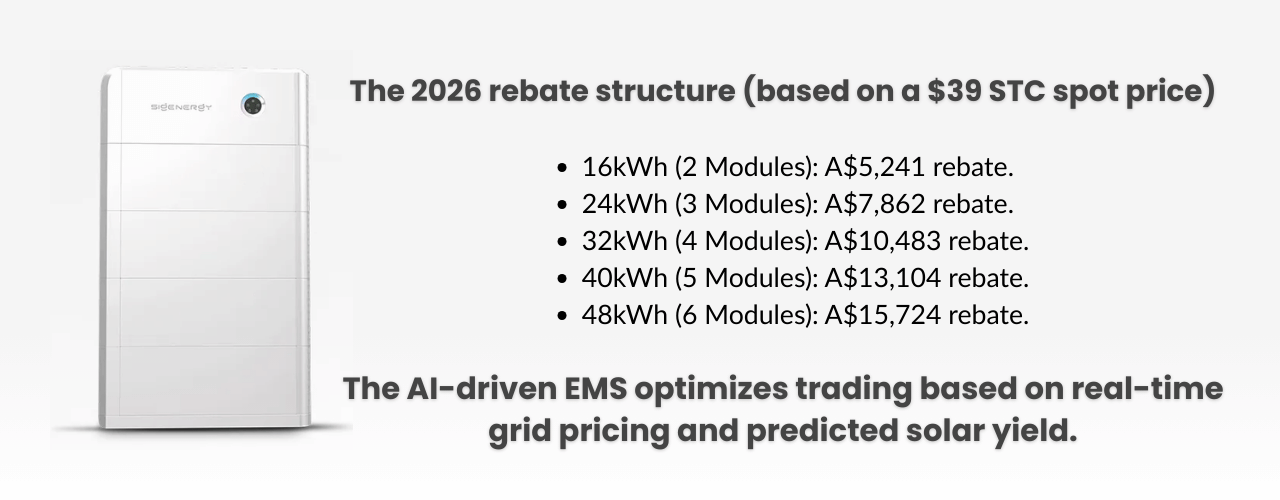
The 2026 rebate structure favors volume but includes tapering to prevent grid over-saturation. For a Sigenergy system, the math breaks down as follows (based on a $39 STC spot price, which may vary at the time of installation):
- 16kWh (2 Mods): ~$5,241 rebate.
- 24kWh (3 Mods): ~$7,862 rebate.
- 32kWh (4 Mods): ~$10,483 rebate.
- 40kWh (5 Mods): ~$13,104 rebate.
- 48kWh (6 Mods): ~$15,724 rebate.
Beyond 48kWh, you approach the 50kWh rebate cap, making the 6-module stack the most efficient way to maximize federal support.
Comparison: Sigenergy vs Tesla vs Sungrow
In the 2026 landscape, homeowners usually narrow their choices down to three contenders. The decision depends on your home’s phase connection and your vehicle strategy.
Feature | Sigenergy SigenStor | Tesla Powerwall 3 | Sungrow SBR/SBH |
Max Single Stack | 48kWh | 13.5kWh | 25.6kWh |
EV Strategy | Native DC-to-DC | AC Wall Connector | AC Wallbox |
Backup Switch | 0ms (UPS Grade) | ~20ms – 2s | ~20ms – 2s |
3-Phase Backup | Native & Unbalanced | Requires 1 unit per phase | Native (Symmetric) |
AI Integration | GPT-4o Integrated | Proprietary Algorithm | iSolarCloud |
Why Sigenergy Wins on 3-Phase Unbalanced Backup
Most 3-phase homes do not draw power equally across all three phases. If your air conditioner is on Phase A and your kitchen is on Phase B, a standard “symmetric” inverter (like older Sungrow models) may struggle to direct all battery power to a single phase during a blackout. The SigenStor’s 3-phase controller supports unbalanced output, ensuring 100% of your stored energy can be directed to the phase that actually needs it.
What We See on Real Installations (And Where People Get It Wrong)
One of the biggest misunderstandings with large battery systems is assuming that more capacity automatically fixes performance issues. In practice, the problems usually show up in how the system is wired and controlled, not how many kilowatt-hours are stacked on the wall.
The "Symmetric" Trap
In three-phase homes—especially regional properties—loads are rarely balanced. Air conditioning, pumps, workshops, and kitchens often sit heavily on one phase. When a standard battery inverter can only respond symmetrically (splitting power equally 33% per phase), a large portion of your stored energy is trapped on the wrong phases while you pay for grid power on the heavy phase.
The SigenStor Difference
With SigenStor, the difference is obvious during commissioning. It supports 100% unbalanced output, meaning it can direct its full power to a single phase if that’s where the load is. Instead of forcing the home to adapt to the battery, the battery adapts to the home. For high-load households, that distinction matters far more than headline capacity numbers.
Sigenergy vs Tesla Powerwall: The DC Charging Advantage
When comparing Sigenergy vs Tesla Powerwall, the debate often centers on software, but the real winner is decided in the wiring. The Powerwall 3 is a formidable AC-coupled or hybrid unit, yet it lacks the native DC-to-DC EV charging capability found in the SigenStor.
Standard EV chargers (like the Zappi or Tesla Wall Connector) are AC-based. When your solar panels generate DC power, an AC charger must convert that power twice before it enters your car. A single AC-DC conversion loses 5%. However, the full ’round trip’ (Solar DC → Inverter AC → Charger AC → Car DC) results in a cumulative 10–15% system loss.” The SigenStor’s integrated DC charger bypasses this entirely, delivering power directly from the solar-plus-battery stack to the EV at rates up to 25kW.
Technical Superiority in Backup and Stability
For a modern estate in the Southern Highlands or a high-tech home in Dural, power stability is non-negotiable. The SigenStor offers technical features that the Tesla Powerwall has yet to match:
- V2X Preparedness: The SigenStor hardware is built for Vehicle-to-Home (V2H) backup. This means your EV can act as a secondary battery for your house during a blackout (provided you have a compatible vehicle).
- 0ms UPS Backup: While many batteries take seconds to detect a blackout, the SigenStor offers 0ms switchover. This is professional-grade protection (essential for home offices, servers, or sensitive medical equipment).
- Generator Integration: Unlike the Powerwall, the SigenStor includes a dedicated port for a diesel or petrol generator, allowing for indefinite off-grid operation during prolonged low-sun periods.
EV Charging in the Real World (And Why System Design Matters)
EV charging looks simple on paper, but in practice, it is one of the most demanding loads a home will ever run. Once an EV is plugged in, it draws hard, continuous power for hours, often while you are cooking or running the AC.
The Hidden “Conversion Tax” With conventional setups, solar power is converted from DC to AC, then back to DC again inside the car. This “double handling” typically loses 10–15% of your energy to heat. When charging happens in the evening, those losses show up as higher grid imports, even when your battery appears full.
The SigenStor Difference Because SigenStor handles EV charging natively in DC, energy flows directly from the solar array or battery into the vehicle. There is no conversion tax. During commissioning, the difference is obvious: battery discharge remains steady, voltage stays stable, and the system doesn’t fight the rest of the house for capacity. For a daily EV driver, this means more range from the same sun.
Comparison: Sigenergy vs Sungrow
When comparing the Sigenergy vs Sungrow choice, homeowners are often weighing legacy reliability against futuristic integration. Sungrow has a decades-long presence in Australia with its SBR and SBH battery ranges, which are highly regarded for their value-per-kWh. However, the SigenStor introduces structural and software advantages that alter the value proposition for tech-forward users.
Scalability and Footprint
The Sungrow SBR system typically scales to 25.6kWh per tower. To reach 48kWh, a Sungrow owner would need two separate towers, requiring double the floor space and additional external wiring. In contrast, the SigenStor reaches 48kWh in a single, vertical column. This vertical density is often the deciding factor for urban garages in Chatswood or Norwest where wall space is at a premium.
Backup Speed and Capability
While Sungrow offers reliable backup through its hybrid inverters, there is often a short disruption (up to 2 seconds) during the switchover. Sigenergy provides true 0ms switchover, which is technically classed as UPS-grade. For homeowners running sensitive home office equipment or medical devices, this “blackout-proof” continuity is a significant engineering upgrade.
EV Integration
Sungrow remains largely focused on the AC ecosystem. Charging an EV from a Sungrow battery requires an external AC wallbox, incurring conversion losses. The Sigenergy SigenStor’s native DC charging module allows for DC-to-DC charging, maintaining higher system-wide efficiency and reducing the hardware clutter on the garage wall.
Sigenergy Single-Phase vs. Three-Phase Systems
Understanding the engineering limits of your Energy Controller is essential for compliance and performance.
Single-Phase (SP) Mastery
Standard suburban residences typically use the 5.0kW to 10.0kW SP Energy Controllers.
- Oversizing: Sigenergy supports a massive 2.0 DC/AC ratio on single-phase. A 6kW inverter can handle up to 12kW of solar panels, directing the “excess” 6kW directly into the battery modules.
- Expansion: Even on a single-phase 6kW inverter, you can stack up to 48kWh of storage (6 modules).
Three-Phase (TP) Dominance
For regional NSW estates and commercial viticulture in the Hunter Valley, the 15.0kW to 30.0kW TP units are required.
- Solar Capacity: A 30kW TP Energy Controller can manage 48,000W of PV. This allows a property to run heavy machinery while simultaneously filling a 48kWh battery stack.
- V2X Preparedness: The 25kW DC EV module is best paired with a 3-phase controller to ensure the house has enough “overhead” to charge the vehicle at maximum speed while running household loads.
The AI Solar Battery System: Trading with GPT-4o
The term Best AI Battery is often used loosely, but Sigenergy is the first to integrate a Large Language Model (GPT-4o) directly into the energy management interface. This isn’t just about a “chatty” app; it’s about the democratization of complex energy trading.
In New South Wales, the rise of Virtual Power Plants (VPPs) and wholesale-exposed plans (like Amber Electric) has turned electricity into a volatile commodity. Prices can swing from -$0.10/kWh to $19.00/kWh in minutes. A standard “smart” battery follows a static schedule. The SigenStor’s AI “brain” monitors real-time wholesale price spikes, hyper-local weather patterns, and your historical consumption habits.
Financial Modeling: The "Double Dip"
For Sydney homeowners, the financial advantage is compounded through the NSW Peak Demand Reduction Scheme (PDRS).
- The Federal Rebate: Up to $15,724 upfront discount.
- The NSW VPP Incentive: Connecting a battery to a VPP can earn an additional payment. Note: Systems over 28kWh are currently capped or ineligible for certain PDRS installation rebates, so for a 48kWh stack, we focus on ongoing trading revenue rather than the small upfront VPP installation bonus.
- Trading Revenue: AI-driven discharge during $15/kWh spikes can yield hundreds in credits per month.
Safety Engineering: The 5-Layer Shield
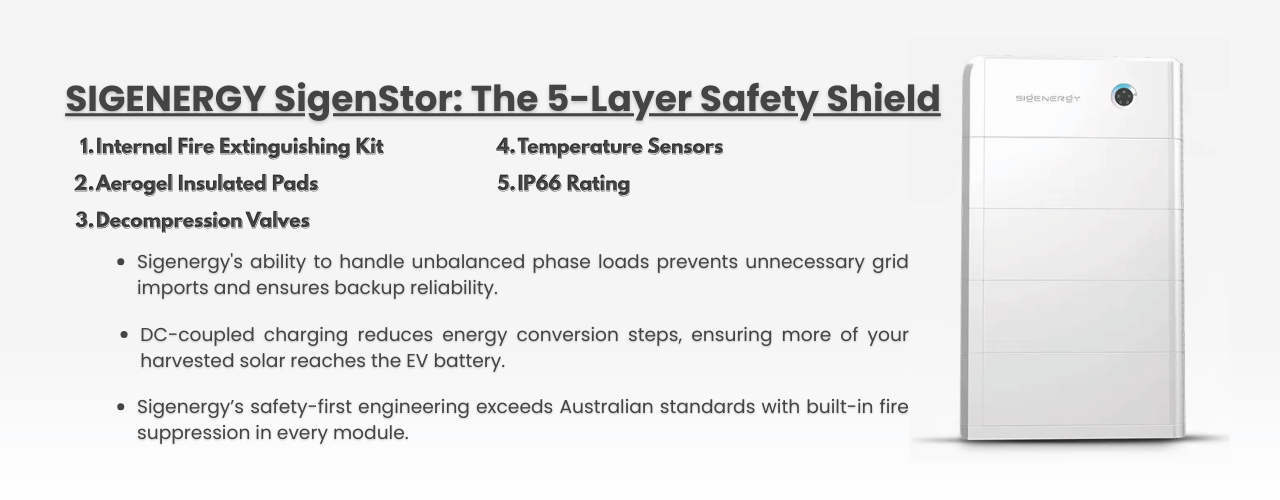
One reason Opera Solar prioritizes the SigenStor is its uncompromising approach to safety. Battery fires are rare, but for an indoor installation, the risk must be mitigated to near-zero. Sigenergy employs a 5-layer protection system:
- Internal Fire Extinguishing Kit: Each battery module contains a kit that automatically activates if temperatures reach critical levels.
- Aerogel Insulated Pads: These block heat transfer between cells, preventing thermal runaway.
- Decompression Valves: To safely vent internal pressure.
- Temperature Sensors: Real-time monitoring of every individual cell.
- IP66 Rating: The highest in its class, ensuring the unit is completely dust-tight and protected against powerful water jets.
The May 1st Deadline
The Sigenergy SigenStor price in Australia is currently at its most competitive point due to the alignment of high STC values and maturing hardware production. However, the impending 19% rebate drop on May 1st, 2026, creates a hard ceiling for maximum ROI.
Investing in a 48kWh AI-integrated stack is no longer about being green; it is about energy sovereignty. By combining high-density storage, DC-coupled EV charging, and GPT-4o intelligence, you are effectively installing a small, private utility company in your garage.
Frequently Asked Questions: The SigenStor Strategy
These answers address the technical and financial logistics for Australian homeowners, farmowners, and businesses moving beyond standard solar into high-performance energy management.
How much does Sigenergy SigenStor cost in Australia in 2026?
In the current Feb 2026 market, a standard 16kWh entry-level setup (comprising the Energy Controller, two battery modules, and the Gateway) typically costs between $16,000 and $18,000 fully installed. For those requiring a commercial-grade 48kWh stack, hardware and installation range from $40,000 to $46,000 before rebates. Because SigenStor is a “5-in-1” unit, it consolidates the hybrid inverter, DC charger, and EMS, which frequently reduces total project hardware costs by several thousand dollars compared to separate component purchases.
What is the 2026 Federal Battery Rebate for Sigenergy?
Under the current “Cheaper Home Batteries” Program, the rebate is calculated using an STC factor of 8.4 until April 30, 2026. For a maximum 48kWh SigenStor configuration, this provides a projected $15,724 upfront discount (calculated at $39/STC. STC price may vary based on your region and on the day of installation). It is important to note that on May 1st, 2026, the factor is scheduled to drop to 6.8, which will materially reduce the rebate value. Accessing the current rate before this winter deadline is a significant factor in the system’s projected internal rate of return (IRR).
Can I use my EV to power my house with a SigenStor?
Yes, provided you have the right hardware and a compatible vehicle. The SigenStor is engineered with bidirectional DC-to-DC architecture, meaning it is hardware-ready for Vehicle-to-Home (V2H) backup. When paired with the 25kW DC Charging Module, the system can draw power from an EV battery to support the home during a blackout. This is currently operational with 2026 CCS2-standard vehicles like the Volvo EX30 and BYD Atto 3, effectively turning your car into a secondary 60kWh+ backup battery.
Why is "Unbalanced Output" a priority for 3-phase homes?
Most 3-phase batteries on the Australian market are “symmetric,” meaning they discharge power equally across all phases regardless of where the load is. If your air conditioning is drawing 5kW on Phase A and the rest of the house is quiet, a symmetric battery would only provide Phase A with a third of its power, forcing you to pay for the rest from the grid. SigenStor supports 100% unbalanced output, directing the full battery discharge to the specific phase under load to prevent unnecessary grid imports.
Sigenergy vs Tesla Powerwall 3: Which is better for backup?
While both systems offer high-end storage, the SigenStor provides 0ms UPS-grade backup, ensuring that sensitive electronics like home servers or medical equipment do not flicker or reboot during a grid failure. In contrast, the Powerwall 3 typically has a short switchover delay. Furthermore, SigenStor includes a dedicated generator input port with auto-start capability. If solar production is low for an extended period, you can integrate a petrol or diesel gen-set to maintain the stack indefinitely.
Can I start with a small battery and expand it later?
The modular vertical design allows you to start with a 16kWh base and add 8kWh modules at any time without external wiring. However, from a strategic perspective, it is often more efficient to size for your three-year projected load now. This ensures you capture the maximum rebate levels (if available at the time of purchase and installation) and avoids the slight efficiency variances that can occur when mixing brand-new battery cells with those that have been cycling for several years.
What are the Sigenergy warranty requirements for internet connectivity?
To maintain the full 10-year product and performance warranty, Sigenergy requires the system to remain connected to the internet for essential firmware updates and AI optimization. Under Sigenergy’s current warranty terms for Australia, if a system remains disconnected for longer than a month, the warranty coverage may adjust to 5 years from the original activation date.