Solar Battery Rebate 2026: The May 1st Drop and Why Waiting Costs You Up to $9,000+
A Strategic Guide to Government Solar Rebate Changes, the Solar Battery Rebate 2026 Reset, and Compliance Deadlines
Summary: From May 1st, 2026, the Federal battery rebate value drops sharply due to a Deeming Factor reduction (8.4 to 6.8) and new Size Tapering rules. For NSW homes, farms, and commercial sites, delaying the Solar Rebate Deadline can erase between A$858 and A$9,566 in legitimate incentives. This engineering brief details the Solar Battery Price 2026 implications and the Level 3 grid constraints that make “waiting” a financial risk.
The Mechanics of the May 1st Cliff
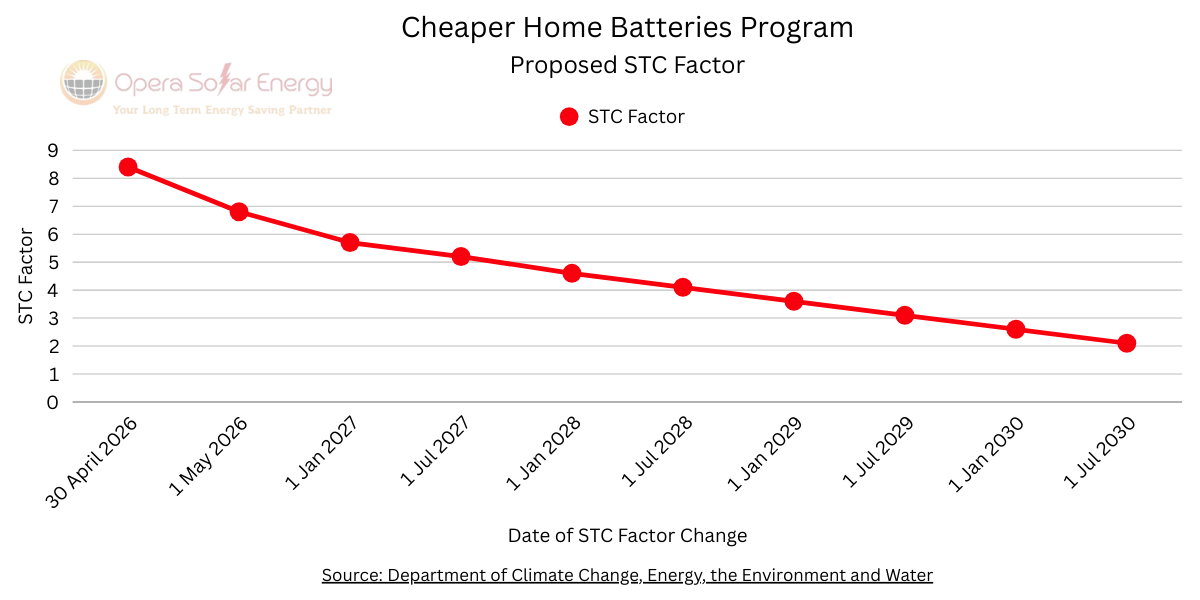
The Government Solar Rebate Changes scheduled for 2026 are not a routine index adjustment. They represent a structural reset of the renewable energy incentive framework. The program operates on a “Deeming Period” mechanism. Unlike previous years where adjustments occurred annually on January 1st, the 2026 schedule includes a confirmed mid-year correction for May 1st.
This change bifurcates the market into two distinct financial phases:
Phase A (Now – April 30, 2026): The Deeming Factor is locked at 8.4. This represents the maximum remaining subsidy life for the system.
Phase B (May 1 – Dec 31, 2026): The Factor drops to 6.8. This is a statutory reduction of approximately 19% in the base value of every certificate generated.
In practice, this means the same physical battery—identical lithium cells, same inverter topology—produces materially fewer certificates overnight. Nothing about the hardware changes. Only the policy lens applied to it does.
The Hidden Second Lever: Size Tapering Behind the Meter
While the drop in the base Factor is significant, the secondary regulatory change—Capacity Tapering—poses a far greater financial risk for larger estates, farms, and commercial facilities.
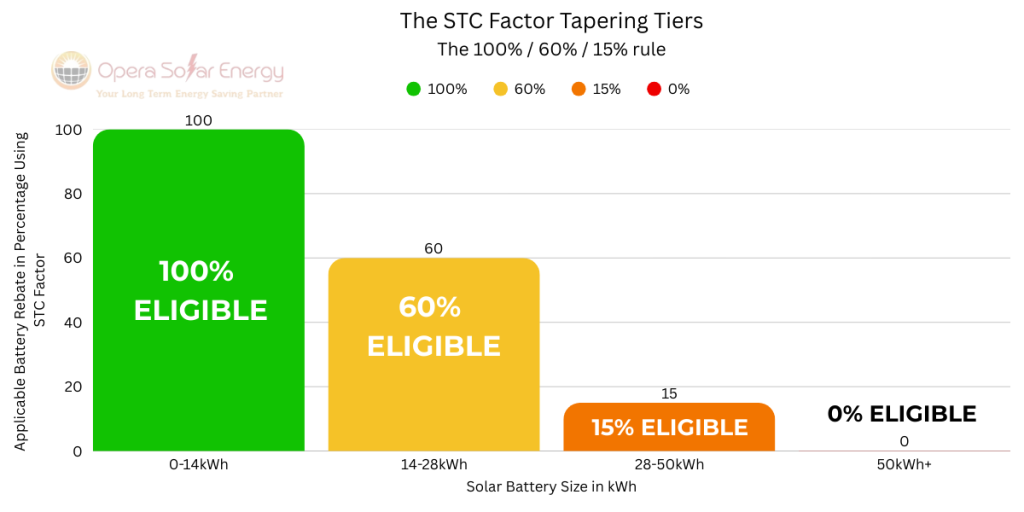
From May 1st, the linearity of the subsidy breaks. The regulator is introducing tiered caps to the capacity installed behind the Network Meter Identifier (NMI).
0 – 14 kWh: 100% Eligible (Factor 6.8).
14 – 28 kWh: 60% Eligible (You lose 40% of the rebate value on this portion).
28 – 50 kWh: 15% Eligible (You lose 85% of the rebate value on this portion).
50 kWh+: 0% Eligible.
Above 28 kWh, the rebate no longer scales linearly with storage size.
Commercial Note:This tapering tax specifically targets the “Energy Independence” segment—larger homes in Dural or Norwest running twin-Powerwall setups, and agricultural sites in the Hunter Valley.
Financial Impact Analysis: The Cost of Waiting
We have modeled three distinct scenarios to forecast the effective Solar Battery Price 2026 impact. These figures act as a static STC Rebate Calculator, showing the exact capital erosion caused by waiting past the May 1st cutoff.
Scenario A: The Suburban Retrofit (13.5 kWh)
Profile: Standard residential dwelling adding a single Tesla Powerwall 3.
Metric
Phase A (Before Apr 30)
Phase B (After May 1)
Rebate Value (Est.)
~A$4,407
~A$3,549
Net Difference
-A$858.00
Commercial Context
Equivalent to ~2.5 years of grid supply charges.
Scenario B: The "Energy Independence" Estate (27 kWh)
Profile: Large semi-rural home (Dural/Hawkesbury) with Twin-Stack.
Metric
Phase A (Before Apr 30)
Phase B (After May 1)
Rebate Value (Est.)
~A$8,814
~A$5,772
Net Difference
-A$3,042.00
Commercial Context
Equivalent to the cost of a premium hybrid inverter.
Scenario C: The Agricultural / Commercial Hub (50 kWh)
Profile: 3-Phase Farm Workshop or Irrigation Pumps.
Metric
Phase A (Before Apr 30)
Phase B (After May 1)
Rebate Value (Est.)
~A$16,380
~A$6,814
Net Difference
-A$9,566.00
Commercial Context
The "Procrastination Tax" (Breaks Short-Term ROI models).
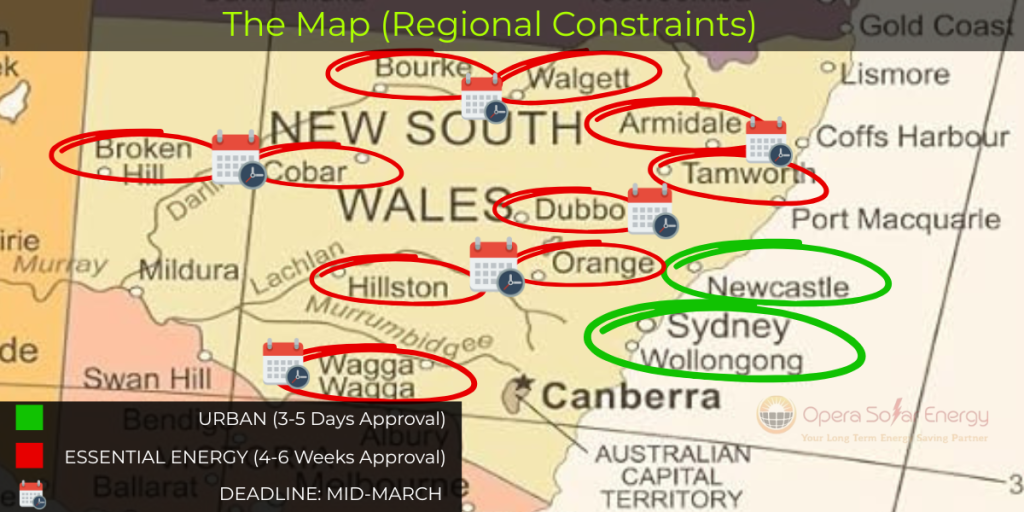
While the statutory date is May 1st, the engineering reality on the ground in NSW dictates a much earlier timeline for specific demographics. This is particularly critical for properties located within the Essential Energy network (Regional NSW, Hunter Valley, Southern Highlands) where grid connection rules are far more stringent than in the city.
In urban zones like Ausgrid or Endeavour Energy, grid connection approvals for standard systems typically turn around in 3 to 5 business days via an automated portal. Regional networks function differently. Larger systems (typically anything exceeding 30kVA of inverter capacity) often trigger a Level 3 Engineering Assessment.
This is not a rubber-stamp process. It involves a manual technical review by the DNSP (Distribution Network Service Provider) to ensure the local transformer can handle the additional load and, critically, the export potential.
The Workflow of Delay:
Voltage Rise Calculation: The engineer must prove that injecting power at your site won’t push the local grid voltage above 258V. On long rural lines (SWER lines), this is frequently a failure point requiring cable upgrades.
Transformer Capacity Check: If the local pole-top transformer is already near saturation from neighbors’ solar, you may be restricted to “Zero Export,” which changes the financial modelling entirely.
The Queue: These assessments currently carry a lead time of 4 to 6 weeks.
Regional assets face stricter timeline constraints due to grid engineering.
The danger lies in the sequence of events. You cannot claim the STC rebate (Phase A) until the system has a valid grid connection approval. Therefore, if you are a landowner in the Southern Highlands planning a 50kWh system, waiting until April to sign a contract is too late. Your application will still be in the engineering queue when the May 1st deadline passes.
To secure Phase A funding for large regional systems, Level 3 applications must be lodged by mid-March. This allows the necessary buffer for the DNSP to clear the application before the federal cutoff.
MODULE B: The NSW Battery Incentive (PDRS Stacking)
Beyond the federal changes, NSW property owners currently have access to a unique arbitrage opportunity by stacking the Federal STC with the NSW Battery Incentive known as the Peak Demand Reduction Scheme (PDRS). This is often described casually as a “double dip,” but the mechanics are specific and compliance-heavy.
The PDRS is a state-based incentive designed to lower grid demand during peak windows (typically summer evenings). Unlike the STC, which is based on installed capacity, the PDRS rewards the capability of the battery to interact with the grid.
How the Cash Flow Works:
The Upfront Discount (PDRS): By committing the battery to a Virtual Power Plant (VPP) contract, the aggregator generates Peak Reduction Certificates (PRCs). These are sold to liable entities, and the cash value is passed to you as an upfront point-of-sale discount.
The Ongoing Yield (VPP): This is separate. This is the monthly or quarterly credit you receive for actually letting the retailer (like Amber, Origin Loop, or AGL) discharge your battery during price spikes.
The Trap: Compliance is binary. The battery must be VPP-capable. Grey imports or older hardware that lacks the specific firmware required for API communication with the grid do not qualify. Furthermore, if a system is installed in “island mode” or “self-consumption only” mode without VPP capability enabled, the NSW Battery Incentive is invalid.
The combination of the Phase A STC rebate and the PDRS incentive creates a subsidised entry point that is unlikely to be repeated once the tapering rules apply.
MODULE C: Hardware Duel (Tesla Powerwall Rebate vs. Sigenergy)
With the tapering rules punishing systems over 14kWh, hardware selection becomes a strategic game. Two primary contenders dominate the NSW commercial and high-end residential market: the Tesla Powerwall 3 and the Sigenergy SigenStor.
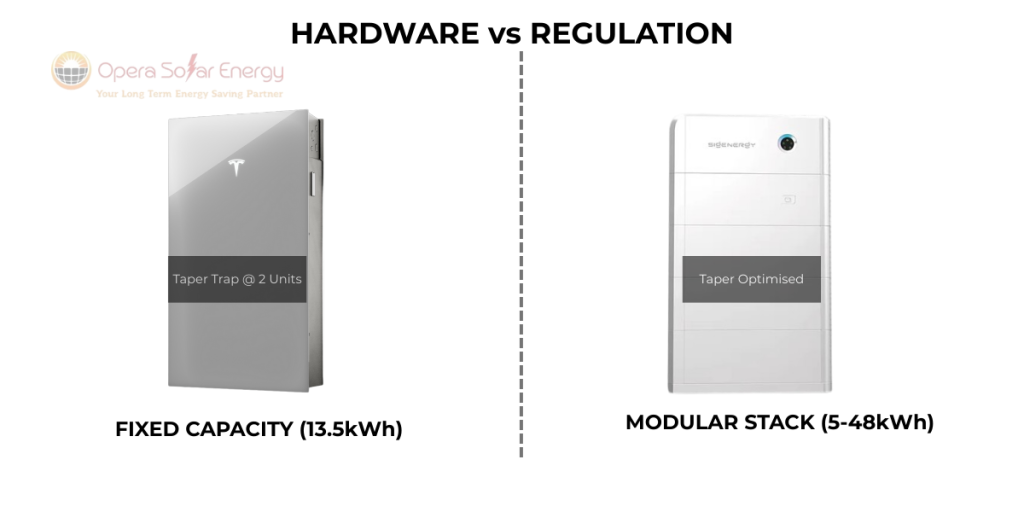
Tesla Powerwall 3 (The Fixed Block) The Powerwall 3 is a fixed 13.5kWh block.
The Taper Trap: While the Tesla Powerwall Rebate value is excellent for a single unit, installing two Powerwalls brings you to 27kWh. Under the new rules, the first 14kWh gets the full rebate, but the remaining 13kWh falls into the “60% Eligible” bracket. You cannot physically install “1.5 Powerwalls” to optimise the tier.
The Limitation: It is primarily a single-phase backup unit. While it works on 3-phase homes, it will only back up one phase during a blackout unless you stack multiple units and install a specialised Gateway, which adds cost.
Sigenergy SigenStor (The Modular Stack) The SigenStor uses a “Lego-block” architecture with 5kWh and 8kWh battery modules that stack vertically.
The Taper Hack: Because it is modular, we can size a system to exactly 14kWh (using distinct modules) to hit the “100% Eligibility” cap perfectly, or size it to 28kWh to max out the “60% Tier” without wasting capital on the “15% Tier.”
The 3-Phase Advantage: Sigenergy inverters have native 3-phase backup built-in. For a farm shed with 3-phase motors, this avoids the need for complex external contactors.
Modular systems allow for precise capacity sizing; fixed blocks do not.
If you are aiming for maximum subsidy efficiency, the Sigenergy allows for surgical sizing. However, if you are a “brand purist” who wants the Tesla ecosystem, you must accept that the second Powerwall will be heavily penalised by the size tapering tax.
Technical Appendix: The Switchboard Compliance Checklist
Securing these financial outcomes requires strict adherence to technical standards. The regulator audits these claims, and non-compliant hardware can lead to the revocation of the entire rebate. But beyond the paperwork, the physical condition of the site often dictates the timeline.
The Asbestos Brake Many NSW meter boards installed prior to 1990 contain asbestos backing panels (zelemite). Legally, we cannot drill into these boards to mount the new smart meters required for VPP participation. If your board is black/dark brown and smells like “old bakelite,” it likely needs a full replacement. This involves Level 2 ASP work and a scheduled outage, adding 2-3 weeks to the project timeline.
Consumer Mains & Thermal Derating For the large agricultural systems identified in Scenario C, the electrical infrastructure often requires upgrades to handle 50kWh of storage charging power. We frequently encounter 3-phase supplies where the “Consumer Mains” (the cable from the street to your house) is only 16mm. Adding a large AC-coupled battery or a high-capacity hybrid inverter requires a review of the cable’s thermal capacity. If the cable is undersized, it must be upgraded to 25mm XLPE to prevent fire risk and voltage drop.
If the existing board lacks distinct circuit protection for the new load, these must be rectified before the battery is commissioned. These remedial works take time. This reinforces the need to start the engineering review process well before the April deadline.
3-Phase Balancing Large single-phase batteries on a 3-phase rural supply can cause phase imbalance issues. If the imbalance exceeds the DNSP’s tolerance (usually 20A–25A differential), the inverter may trip or be rejected by the grid protection relay. This necessitates either a 3-phase battery system (Sigenergy) or careful circuit migration at the board.
Frequently Asked Questions
Is the Solar Rebate Deadline for installation or application?
The critical deadline is for the STC Application. You must have a signed quote and paid deposit, and the claim must be locked by April 30. The physical installation can occur after this date, provided the paperwork is strictly in order.
Can I retrofit a battery to my existing solar and still get the rebate?
Yes. Retrofitting a battery to an existing solar PV array is fully eligible for the STC subsidy. The tapering rules apply based on the total battery capacity behind the meter.
Is the $9,566 loss figure for large systems verified?
Yes. This figure is derived from the removal of the 1:1 subsidy ratio for systems over 28kWh combined with the base factor drop. It represents the delta between the current incentive structure and the tiered model taking effect in May.
Do non-VPP batteries qualify for the NSW Battery Incentive?
No. Participation in the Peak Demand Reduction Scheme requires VPP-capable hardware with active communications.
The Strategic Window
The convergence of the Deeming Period drop and the introduction of Capacity Tapering creates a definitive financial “before and after” for solar storage in NSW.
For the residential market, the loss is frustrating but manageable. For the commercial and agricultural sectors, the loss is capital-intensive. A A$9,566 differential on a 50kWh asset significantly alters the ROI and payback modelling.
The window to secure Phase A funding is closing. For regional assets requiring Level 3 grid assessments, that window effectively closes in mid-March. We advise all commercial and estate operators to finalise their engineering reviews immediately to ensure improved asset feasibility.
Disclaimer: All engineering and financial figures are estimates for modelling purposes only. Final yield is subject to site inspection and DNSP approval. Rebate values fluctuate with STC market prices.