
Reading an objective JA Solar Panels Review Australia is a practical first step before committing to a home energy upgrade. JA Solar has shifted the premium market landscape with its DeepBlue 4.0 Pro and DeepBlue 5.0 Pro technology platforms. These modern solar panels deliver exceptional efficiency using proprietary Bycium+ 5.0 cells. They offer a highly versatile range of wattage options to suit almost any Australian roof size.
Here are the key takeaways for homeowners exploring JA Solar hardware:
Read below to discover exactly how this modern solar hardware operates. We will explore the comprehensive 2026 product range and answer the most technical questions from Australian buyers.
Choosing the right solar brand is often a demanding decision for homeowners. The Australian market is flooded with dozens of competing labels. However, JA Solar consistently stands out as a globally recognised Tier 1 manufacturer.
Founded in 2005, the company possesses a substantial worldwide production capacity. This scale ensures their products are readily available globally. It also allows them to invest consistently in top-tier research and development. Furthermore, it means they maintain a permanent corporate footprint in Australia to handle any future support claims directly.
Unlike budget brands that simply assemble parts bought from third-party factories, JA Solar is completely vertically integrated. This is a substantial advantage for the consumer. It means JA Solar builds and controls every single step of the complex manufacturing process.
They manufacture their own silicon ingots. They slice their own wafers. They build their own solar cells and finally assemble the finished module. This complete manufacturing control ensures strict quality oversight at every stage. It makes them a trusted and reliable choice for Australian homeowners wanting a system built to last for decades.
When you purchase solar panels with a thirty-year warranty, you need certainty that the company will still exist to honour it. JA Solar holds excellent financial bankability ratings. They are a multi-billion-dollar enterprise with a proven global track record.
This financial strength is a major consumer trust signal. It guarantees that their local Australian support offices will be appropriately funded to assist you for the entire lifespan of your solar system. You are not buying a cheap panel from a temporary manufacturer that might close its doors next year.
The latest JA Solar Panels utilise advanced internal engineering. By upgrading to the new DeepBlue 4.0 Pro and DeepBlue 5.0 Pro technology platforms, JA Solar has successfully pushed commercial cell efficiency to leading industry benchmarks.
This places them among the leading high-efficiency solar platforms currently available. But what exactly makes these new panels perform better than the older models installed just a few years ago? The answer lies in the microscopic cell chemistry.
The Bycium+ 5.0 Cell Innovation
The standout feature of the DeepBlue 5.0 series is the integration of JA Solar’s proprietary Bycium+ 5.0 cell technology. This is an advanced iteration of n-type cell architecture. It is specifically designed to maximise energy yield by reducing internal resistance and capturing a broader spectrum of sunlight.
Older P-type PERC models like the JAM54S30 series reliably offer 390W to 415W of power. However, the new Bycium+ 5.0 cells generate noticeably more electricity over their lifespan. They are highly sensitive to weak light, ensuring your system wakes up earlier in the morning and switches off later in the evening.
Reducing Electron Recombination
In older panels, excited electrons can easily recombine before they are pushed out into your home as usable electricity. TOPCon technology adds a specialised microscopic tunnel oxide layer to the back of the solar cell to prevent this.
This insulating layer allows the beneficial electrons to pass through easily while blocking the negative recombination effects. Ultimately, this means a larger percentage of the sun’s raw energy makes it down into your solar inverter to power your home appliances.
Gapless Flexible Interconnection (GFI) Explained
A major structural innovation in the current JA Solar range is Gapless Flexible Interconnection. If you look closely at older solar panels, you will see visible empty white lines between the square silicon cells. That is essentially dead space that produces absolutely zero power.
JA Solar has engineered a clever way to slightly overlap the individual solar cells. They use a specialised flexible ribbon to connect the cells seamlessly. This completely eliminates all the dead space across the front surface of the panel.
It packs more active silicon into the exact same physical frame footprint. This engineering strategy results in a noticeable boost to the overall power output without making the panel physically larger on your roof.
The Shock Absorber Analogy
The flexible ribbon used in the Gapless Flexible Interconnection process does more than just save space. It acts as a tiny shock absorber. When summer heat causes the panel to expand, or when high winds cause the roof structure to vibrate, this flexible ribbon bends naturally.
This physical flexibility reduces the mechanical stress placed on the fragile silicon cells. It lowers the risk of microscopic cracks forming over a thirty-year period. This ensures your panel remains productive and entirely safe throughout its operational life.
When researching the best solar hardware, physical panel dimensions and power output are crucial factors. JA Solar offers a versatile product portfolio tailored for very different applications. They have specifically engineered distinct panel sizes for standard suburban homes and expansive industrial warehouses.
Choosing the right panel ensures your installer can fit the maximum amount of power onto your specific roof safely. It also ensures you are not paying for heavy commercial frames that are totally unsuitable for a standard domestic property.
Residential Power: The 440W to 475W Series
For standard residential homes, the 54-cell format is the ideal fit. Newer models like the DeepBlue 4.0 Pro panels are currently popular in the Australian residential market. The 440W JA Solar Panels are specifically designed to be easily manageable. This makes them straightforward for local installation crews to handle on steep suburban roofs.
These panels provide substantial power without taking up too much physical space. If you have a slightly larger roof, the 475W JA Solar Panels offer even greater generation capacity. This sizing flexibility makes JA Solar Panels Australia a premium choice for modern households wanting to maximise their roof space.
Premium Residential and Light Commercial: 485W to 550W
A major advantage of the DeepBlue 5.0 lineup is its versatility. JA Solar does not restrict this premium technology to massive commercial projects. They have engineered highly capable mid range panels for large residential homes and light commercial buildings.
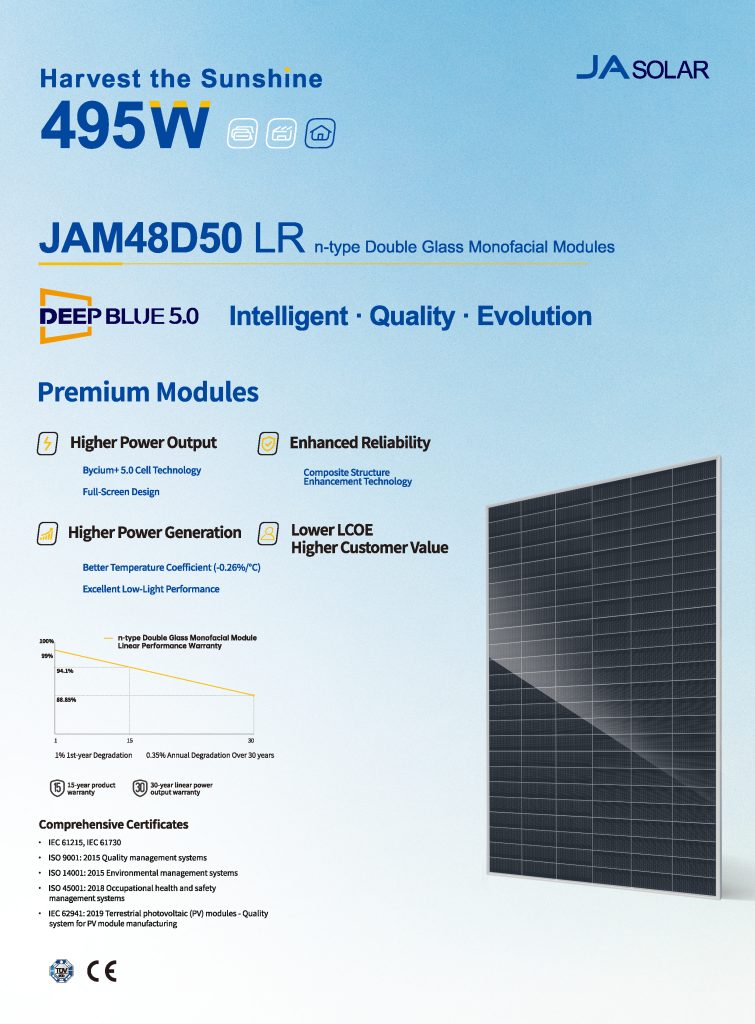
The JAM48D51 series offers powerful 485W panels, while the JAM48D50 series pushes this to 495W. For property owners wanting even more generation from a single panel, the JAM54D51 series reaches 540W and the JAM54D50 series peaks at a robust 550W.
This versatile sizing flexibility makes JA Solar panels Australia a premium choice. It allows your installer to select the exact physical dimensions required to maximise the power output of your specific roof layout.
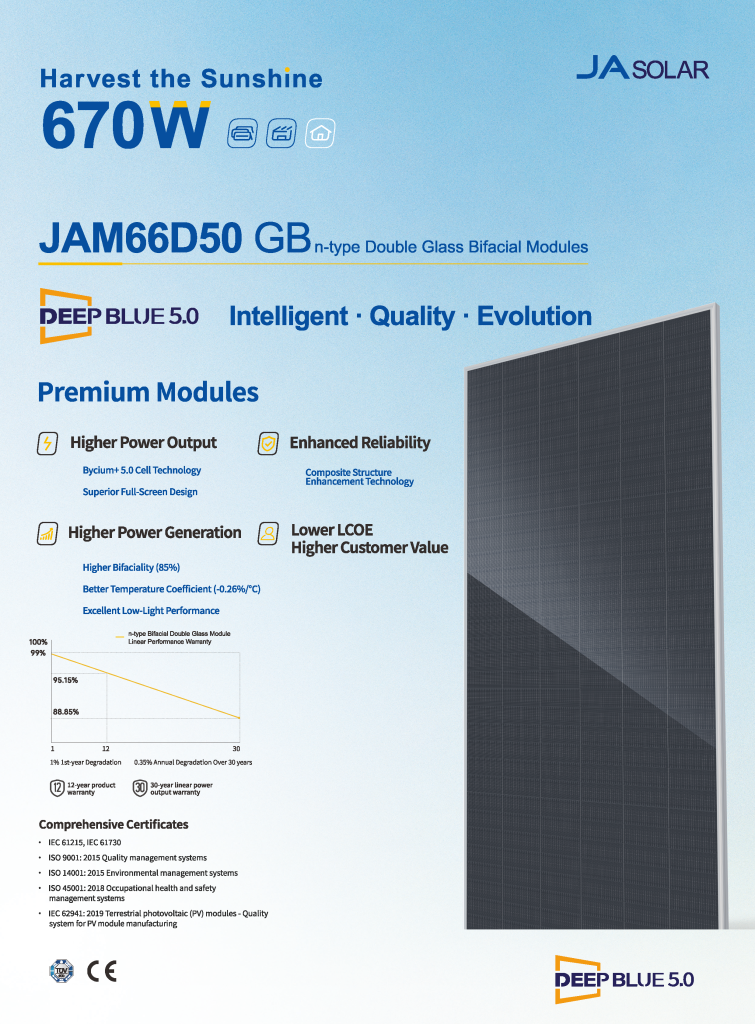
For massive commercial roofs and utility farms, JA Solar builds substantial, high-yield modules. The DeepBlue 5.0 JAM66D50 series reaches an impressive 670W of power.
These heavy-duty modules use a much larger 66-cell configuration to reach this robust power output. While they are far too large and heavy for a standard suburban home, they are an excellent solution for industrial warehouses. They allow commercial property owners to slash their daytime operating costs by using fewer physical modules.
Australia has one of the most demanding environments globally for rooftop solar hardware. Your panels must survive summer heatwaves, corrosive coastal salt spray, and severe physical impacts from seasonal hailstorms.
JA Solar has explicitly engineered its panels to handle these exact local conditions. They utilise advanced materials and reinforced structures to ensure reliable performance across the entire country, from the humid eastern coastline to the dry outback.
Many of the new JA Solar models feature a robust double glass monofacial or bifacial design. Standard budget panels typically use a basic plastic backsheet. JA Solar replaces this plastic with a solid sheet of toughened glass on the back of the module.
This dual glass structure is significantly more durable over decades. It completely seals and protects the delicate internal Bycium+ 5.0 cells from moisture and salty coastal air. This makes them highly suitable for beachfront properties.
Furthermore, on specific bifacial models, the transparent glass back allows the underside of the panel to capture extra sunlight bouncing off the roof underneath. This bifacial technology provides a completely free boost to your daily energy generation.
Australian summers are famously punishing on standard electrical hardware. As temperatures rise, ordinary solar panels naturally lose their ability to generate electricity efficiently. JA Solar panels are specifically engineered for excellent heat management.
Thanks to the Bycium+ 5.0 technology, these DeepBlue 5.0 panels feature an outstanding temperature coefficient of negative 0.26 percent per degree Celsius. This means the internal chemistry is designed to run noticeably cooler under Australian direct sunlight. On a 40 degree day, a JA Solar panel will suffer less power degradation than a cheaper budget alternative.
While double glass panels offer exceptional durability, they introduce a distinct challenge for installation teams. Glass is heavy. A double glass panel weighs noticeably more than a traditional plastic-backed panel.
Your chosen installer must carefully verify that your roof trusses are structurally sound enough to handle this extra weight safely. Reputable installers will always conduct a proper site inspection to ensure your property can support the superior double glass technology without risking long-term structural sagging.
Cyclonic winds and severe hail are real threats across many Australian states. Physical strength is absolutely non-negotiable for rooftop equipment. JA Solar Panels are internationally certified for better mechanical loading tolerance.
This robust physical framing ensures the panels will not flex excessively or snap during severe weather events. Whether you face high coastal winds or heavy inland storms, the reinforced aluminium frames keep the internal silicon cells secure and functional.
When investing in a solar system, you need confidence that your chosen manufacturer will support you over the long term. JA Solar provides strong local support for Australian buyers to ensure complete peace of mind during the lifespan of your system.
The 25 Year Product Warranty
The product warranty protects you against physical flaws in manufacturing or component materials. Depending on the exact technology, JA Solar offers varying guarantees. Even their standard P-type panels feature a generous 25-year product warranty. This ensures that if the physical hardware fails due to a factory defect, you are appropriately covered.
The 30 Year Performance Promise
All solar panels naturally degrade over time as they are exposed to ultraviolet light. However, the advanced Bycium+ 5.0 double glass models push degradation rates to an industry low.
They guarantee the panel will lose a maximum of 1 percent of its power in the first year, and only 0.35 percent annually after that. This translates to an exceptional 30 year performance promise. This incredibly low degradation rate ensures your financial return on investment remains strong well into the future.
Making a confident choice means looking objectively at both the positive and negative aspects. The pros of choosing JA Solar Panels are substantial. You get excellent efficiency, advanced N-Type TOPCon technology, and a 30 year performance warranty.
The cons are mostly physical and brand related. Double glass panels are heavy. Your installer must verify that your roof structure is strong enough to handle this extra load. Additionally, as a massive volume brand, JA Solar lacks the boutique prestige of some expensive European panels.
When homeowners evaluate JA Solar Panels vs AIKO, JA Solar Panels vs Longi, JA Solar Panels vs Trina Solar, or compare JA Solar Panels vs JINKO, JA Solar holds its ground firmly. They often offer identical TOPCon efficiency but sometimes at a slightly sharper price point. The specific price of JA Solar Panels in Australia will vary by installer, but they consistently represent solid value.
Upgrading your home with Tier 1 solar hardware is a practical financial move to combat rising electricity prices. JA Solar DeepBlue panels offer a balanced mix of proven Bycium+ 5.0 technology, excellent heat tolerance, and overall affordability.
Whether you need a sleek 440W system for your suburban home or robust 550W panels for a large residential property, objective advice is essential. We strongly recommend working with accredited professionals to supply and install premium green energy systems tailored to your specific roof layout.
Click the button below to request a comprehensive solar proposal. Let expert technicians show you exactly how much your family can save using JA Solar technology today.
When consumers research high-value solar system hardware on forums like Reddit, they demand objective answers. Here are the clear, factual responses to the ten most common concerns for Australian Homeowners, Businesses, and Farmowners regarding JA Solar Panels.
Yes. When researching JA Solar Panels vs Trina or Qcells, JA Solar stands out as a globally recognised Tier 1 manufacturer. They control their entire vertically integrated production line. They offer identical or superior TOPCon efficiency at a competitive price.
The exact JA Solar Panels price depends on your location, roof difficulty, and chosen installer. Generally, a standard residential system is cost-effective. It offers a faster return on investment compared to buying premium European brands.
DeepBlue 5.0 Pro is a recent release pushing wattage limits for commercial output. DeepBlue 4.0 Pro is primarily tailored for high-performance residential and small commercial roofs. Both utilise TOPCon cells for superior low-light yield.
It is JA Solar’s proprietary n-type cell architecture found in their DeepBlue 5.0 range. It reduces internal electrical resistance and provides an excellent temperature coefficient of negative 0.26 percent per degree Celsius.
For a small roof, the 440W to 475W models are the ideal physical size. The 485W to 550W DeepBlue 5.0 panels suit larger homes or light commercial buildings with high energy demands. The 670W modules are strictly designed for flat commercial properties.
It means the individual solar cells are tightly packed together without empty space. This overlapping design uses a flexible ribbon. It generates more electricity from a smaller roof area while acting as a physical shock absorber.
Yes. While tin roofs reflect less light than white roofs, the double glass design still provides essential physical durability. It protects the cells against moisture, coastal air, and summer hail much better than basic plastic backsheets.
Because they use advanced Bycium+ 5.0 cells, they feature a low temperature coefficient. They run noticeably cooler and lose less power in peak heat than older panel technologies. This guarantees more consistent power for your air conditioning.
Yes. The 670W models use a large 66 cell layout. They are physically large and heavy. This makes them unsuitable and often unsafe for standard angled domestic roofs.
Absolutely. If you find yourself comparing JA Solar Panels vs Jinko or JA Solar Panels vs AIKO, you are looking at the top Tier 1 brands globally. JA Solar is recognised for immense manufacturing capacity and financial bankability.
Premium JA Solar panels are specifically designed to last for decades. Backed by up to a 30-year performance warranty with a low 0.35 per cent annual degradation rate, they are a reliable long-term investment.