
For property owners seeking a comprehensive Canadian Solar Panels Review Australia wide, understanding the latest technical specifications is critical before committing to a long-term solar investment. Founded in 2001, Canadian Solar is a bankable Tier 1 manufacturer. This comprehensive guide explores their complete 2026 technology lineup. By shifting to N-Type TOPCon and Heterojunction cell architectures, Canadian Solar achieves premium module efficiencies reaching up to 24.8 per cent.
Key Takeaways for Canadian Solar in 2026:
The Australian renewable energy sector is filled with competing hardware manufacturers. At Opera Solar, our technical philosophy prioritises safety before speed. We focus on long-term system stability rather than chasing the absolute lowest upfront price. Canadian Solar aligns strongly with this engineering approach.
Founded in 2001, Canadian Solar has established itself as a globally dominant Tier 1 solar manufacturer. Despite the North American name, their manufacturing processes are completed in fully automated, state-of-the-art facilities across Asia. This allows them to balance exceptional production quality with practical pricing.
When investing in a solar system designed to last three decades, corporate bankability is paramount. You need absolute assurance that the manufacturer will remain financially stable to honour their performance guarantees. Because Canadian Solar distributes photovoltaic products globally, they offer the corporate security that CFOs and careful homeowners require.
If you are researching a Canadian solar panels review 2026 update, you must look beyond basic marketing brochures. This guide breaks down the precise engineering changes Canadian Solar has implemented. We will examine their rectangular wafer technology, their proprietary inverter ecosystem, and how their hardware handles the demanding Australian climate.
Older solar arrays relied heavily on traditional P-type cell technology. While this was historically reliable, it presented noticeable efficiency limitations. Canadian Solar has transitioned their premium production lines to advanced N-Type cell architectures to future-proof their product range.
N-Type TOPCon and the 182 Pro Rectangular Wafer
The foundation of the 2026 range is the N-Type TOPCon cell. This technology improves the way the silicon captures photons and prevents energy loss. To maximise this technology, Canadian Solar champions the 182 Pro rectangular wafer.
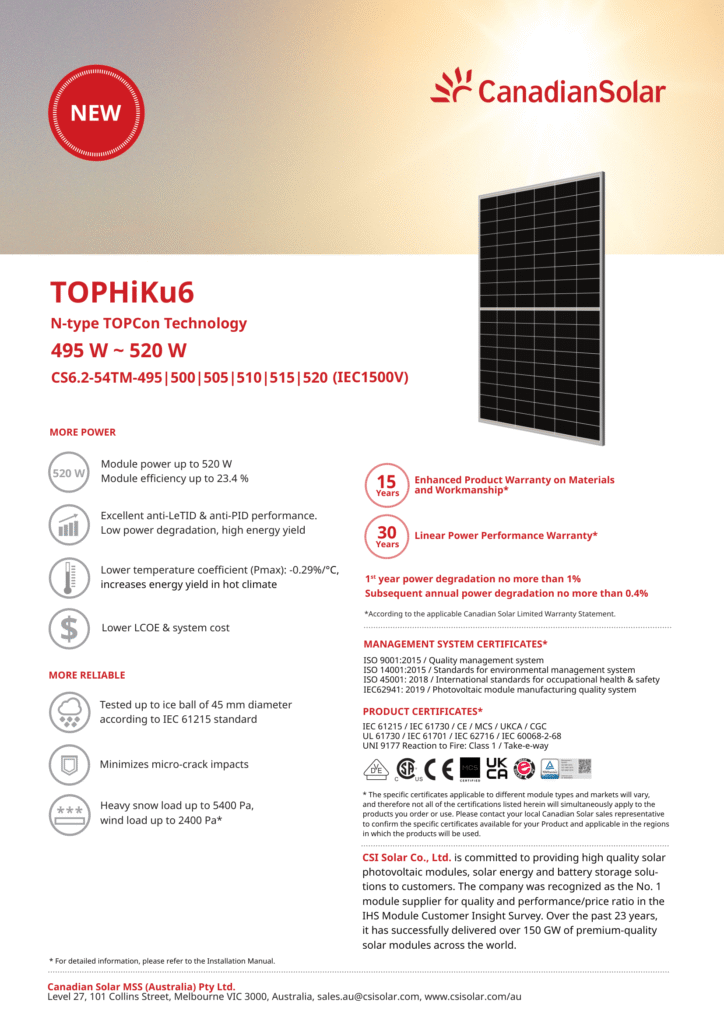
The 182 Pro wafer optimises the 66-cell footprint to exactly 2382 by 1134 millimetres. This rectangular design provides maximum active silicon surface area without making the physical panel unmanageable for installation teams.
Crucially, the 182 Pro wafer drops the operating current to under 11A. This is a vital engineering refinement. Lowering the current ensures seamless compatibility with standard residential string inverters. It prevents electrical clipping and protects your system from generating excess heat during peak summer production.
HJT HiHero: The Low-Carbon ESG Breakthrough
For buyers seeking peak technological performance, the HJT HiHero series represents the premium tier. Heterojunction (HJT) technology combines crystalline silicon with amorphous silicon thin films.
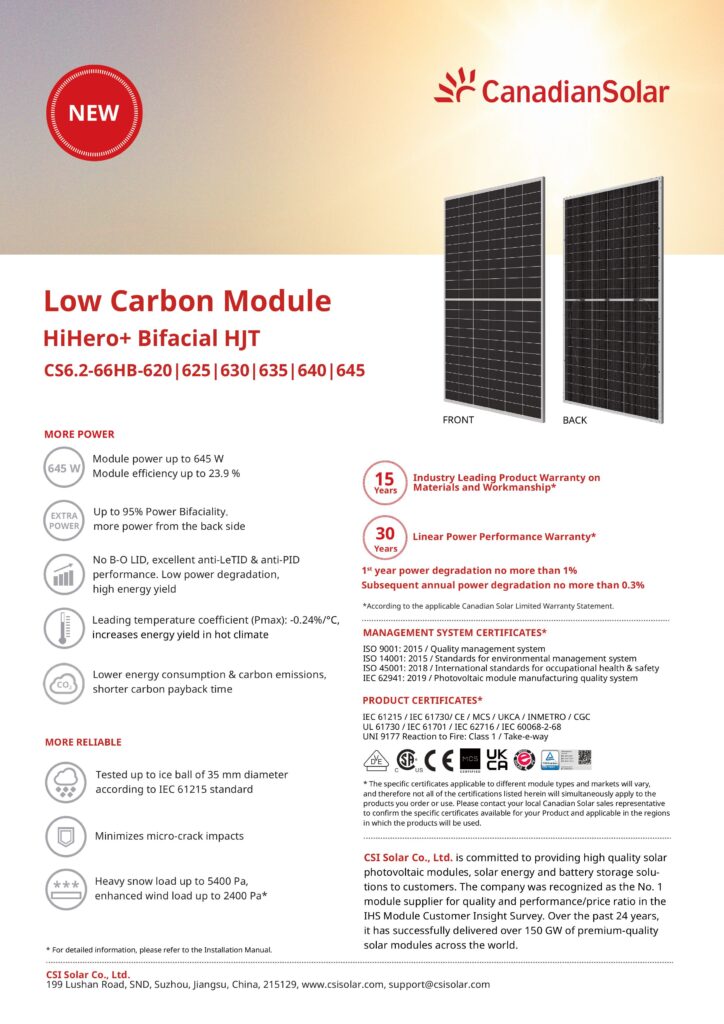
This advanced manufacturing technique reduces the physical wafer thickness to just 110 microns. Despite being thinner, the HiHero series achieves a remarkable 24.8 per cent efficiency. It also boasts a temperature coefficient of -0.24%/°C, meaning it loses very little power when the ambient temperature spikes.
Beyond raw performance, the HiHero series is an environmental leader. Audited by DNV, this series features a carbon footprint of just 285 kg CO2/kWp. This 18 per cent reduction in manufacturing emissions makes it an excellent choice for corporate buyers requiring strict Environmental, Social, and Governance (ESG) compliance.
Selecting the correct panel size is a primary concern for residential properties. The latest Canadian Solar lineup delivers exceptional output within a practical physical footprint. If you are looking for an objective Canadian Solar TOPHiKu6 review Australia wide, the specifications are very strong.
The TOPHiKu6 Series (445W to 475W)
The residential standard is the CS6.2-48TD TOPHiKu6 (N-type Module) series. These panels provide a power range from 445W to 475W. They achieve a peak efficiency of 23.8 per cent, allowing homeowners to generate substantial electricity from limited roof space.
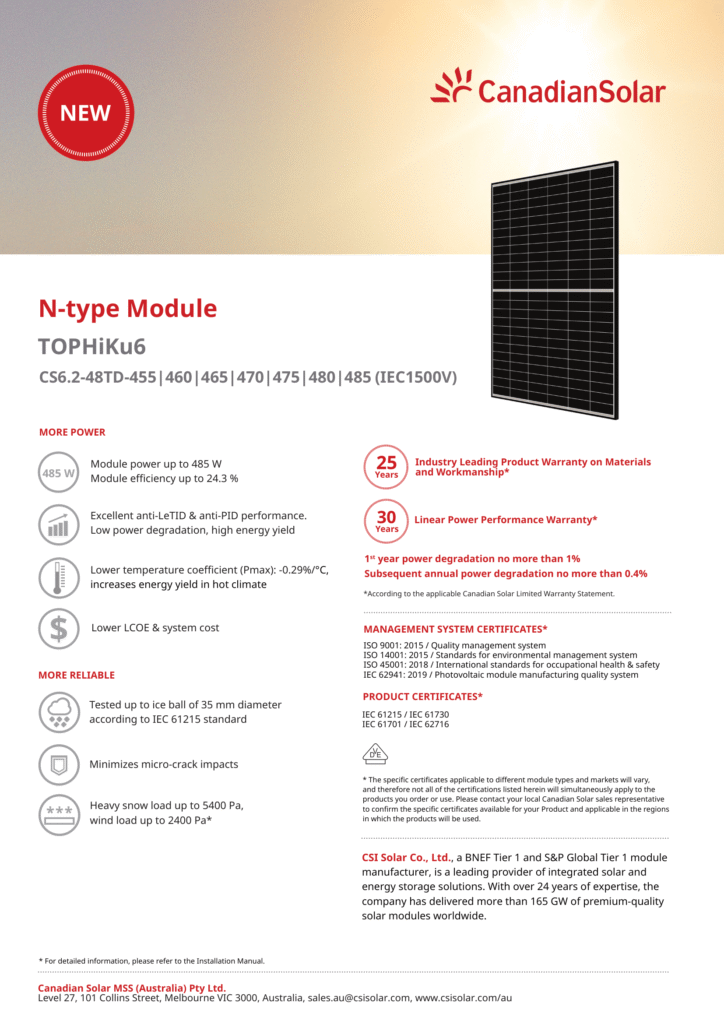
These modules feature dual-glass construction. This means the active silicon cells are protected by tempered glass on both the front and rear surfaces. Dual-glass solar panels are significantly more resilient against moisture ingress and physical stress over a 30-year lifespan.
The All-Black Aesthetic for Modern Roofs
Visual appeal is increasingly important for Australian homeowners. For modern urban rooftops, the TOPHiKu6 470W All-Black variant is exceptionally popular.
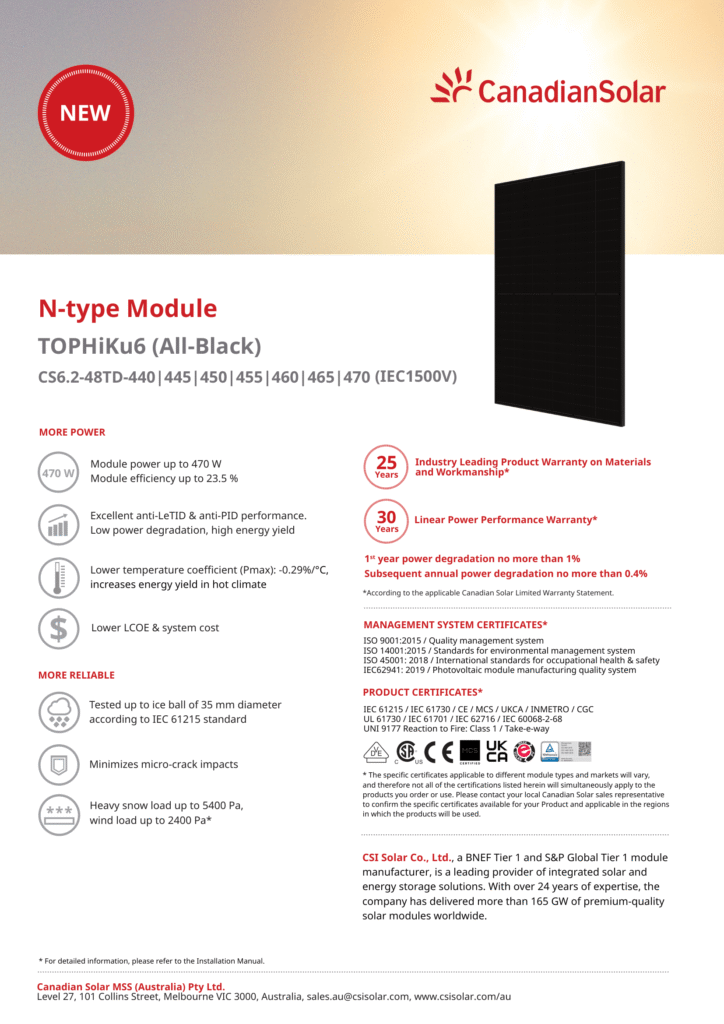
This specific module features a black anodised aluminium frame, a black backsheet, and very dark silicon cells. The result is a flawless, uniform aesthetic that blends perfectly with dark roof tiles or Colorbond steel. This ensures your solar array enhances the architectural value of your property rather than detracting from it.
For industrial applications in areas like Norwest and regional solar farms in the Hunter Valley, raw power output and system efficiency are the main priorities. The heavy-duty commercial range is led by the TOPBiHiKu7 series.
These are N-Type bifacial giants. They push power limits from 695W up to 750W. Because they are bifacial, they feature a transparent rear surface. This allows the panel to harvest direct sunlight from above, as well as ambient light reflecting off the ground below.
From a financial perspective, these large commercial modules offer serious advantages. By using 750W solar panels, installation teams require fewer physical modules to reach the target megawatt capacity.
This reduction in physical hardware directly lowers the required racking infrastructure and cabling. Commercial facility managers can expect a reduction in Balance of System (BOS) costs by up to 2 per cent. Furthermore, the increased efficiency reduces the total Levelized Cost of Energy (LCOE) by up to 5 per cent over the project’s lifetime.
Anyone managing agricultural sites in regions like the Hunter Valley or commercial roofs in regional NSW already knows how quickly dust builds up on outdoor equipment. When dirt pools at the bottom edge of a panel, it creates a hard shadow line that blocks sunlight and severely reduces electrical output.
Canadian Solar has addressed this operational hurdle directly with their TOPBiHiKu6 Anti-Dust modules. The CS6.2-66TB variant features a patented short-edge frame design. The aluminium frame sits flush with the protective glass. This allows rainwater to easily wash away debris and snow without leaving a stubborn mud ridge at the bottom of the panel.
This structural upgrade is proven to minimise dust accumulation on low-tilt installations. By keeping the cells cleaner for longer periods, facility managers do not need to schedule manual cleaning services as frequently, significantly reducing long-term operations and maintenance costs.
A common issue in the Australian solar sector is hardware fragmentation. When an installer uses panels from one brand and an inverter from another, troubleshooting a system failure can be difficult. Canadian Solar solves this by manufacturing a fully integrated ecosystem.
Their proprietary three-phase inverters range from 10kW residential units up to 120kW commercial units. These inverters feature a rugged IP66 rating, meaning they are completely sealed against dust and powerful water jets.
A major technical advantage of the Canadian Solar inverter range is the high-current input capacity. Modern 700W+ commercial panels generate substantial electrical current.
The residential inverters feature a 20A input per string. The larger commercial units are engineered to handle up to 40A per Maximum Power Point Tracker (MPPT). This specific engineering ensures the inverter can process the large currents of modern N-Type panels without suffering from power clipping or internal overheating.
At Opera Solar, we evaluate hardware based on safety features. Canadian Solar inverters include advanced Arc Fault Circuit Interrupter (AFCI) technology. This system actively monitors the electrical cables. If it detects a dangerous electrical arc, it shuts the system down immediately to prevent roof fires.
Additionally, the inverters feature built-in Potential Induced Degradation (PID) recovery. This software applies a reverse voltage to the solar panels at night, effectively repairing minor cell degradation while you sleep.
By installing Canadian Solar panels alongside a Canadian Solar inverter, buyers gain a significant operational advantage. You have a single point of contact for all hardware warranty claims.
If a fault occurs, there is no dispute between competing manufacturers over who is responsible. This single-point ecosystem provides peace of mind for risk-averse homeowners and corporate facility managers who demand clear accountability.
Australia experiences brutal weather patterns. Solar hardware must be built to survive cyclonic wind, severe hail, and blistering summer heat. Canadian Solar modules are rigorously tested to exceed standard baseline requirements.
Standard solar panels are typically tested to withstand 25mm hailstones. Canadian Solar pushes this durability much further. The residential TOPHiKu6 modules are certified to withstand impacts from 45mm hailstones.
For commercial applications, the durability is even more robust. The commercial HiHero Anti-Hail 625W to 665W CS6.2-66HB-HP and CS6.2-66TB-HP are officially certified to survive 55mm hailstones (wider than a standard golf ball) according to strict IEC 61215 testing standards. This certification proves the hardware can survive the severe summer storm fronts common in Queensland and New South Wales.
Extreme Heat and the -0.24%/°C Temperature Coefficient
Solar panels naturally lose generation efficiency as their internal temperature rises. The HJT HiHero series addresses this with an industry-best temperature coefficient of -0.24%/°C.
This means the panel loses only a fraction of a per cent of its power for every degree over 25°C. During a 40-degree summer heatwave, the HiHero series will run significantly cooler and generate far more steady electricity than a standard budget panel.
IP66 Weatherproofing and Coastal Salt Mist Resistance
Many homes in areas like the Northern Beaches or coastal NSW are located near the ocean. Salt mist is corrosive and can quickly degrade standard solar wiring. Canadian Solar panels pass strict IEC salt mist corrosion tests.
Furthermore, the entire Canadian Solar inverter ecosystem is rated IP66. This ensures the internal electronics are completely protected against heavy rain, salt spray, and fine dust, making them an excellent choice for coastal properties.
A solar array is a long-term financial asset. You need total transparency regarding how the equipment will perform over the coming decades. Canadian Solar provides a very reliable and documented warranty structure.
The residential TOPHiKu6 dual-glass panels carry a robust 25-year product warranty. This covers the physical materials against manufacturing defects.
They also feature a 30-year performance guarantee. Canadian Solar caps the first-year power degradation at a maximum of 1 per cent. Following this, the degradation is strictly limited to 0.4 per cent annually for TOPCon models, and just 0.3 per cent annually for HJT models. This mathematical certainty allows you to accurately calculate your long-term energy savings.
Objective comparison is necessary when evaluating top-tier solar hardware. No single brand is perfect for every scenario. Understanding the differences helps buyers make an informed decision for their specific property footprint.
When evaluating Canadian solar panels vs Jinko, both are excellent Tier 1 solar panels options. Jinko is famous for its Tiger Neo TOPCon series and strong low-light performance. Canadian Solar counters this with their fully integrated ecosystem. If you want matching panels and inverters with a single warranty contact, Canadian Solar holds a distinct operational advantage.
When asking which is better, Jinko or Canadian Solar panels?, the answer depends on your priorities. Jinko often provides a slight edge in raw cell efficiency, while Canadian Solar offers superior certified hail resistance on specific commercial models.
When comparing Canadian solar panels vs Longi, Longi is a dominant player known for their back-contact (HPBC) technology and sleek grid-free aesthetics. Canadian Solar is very competitive on price and leads in low-carbon ESG compliance with their DNV-audited HJT HiHero line.
When researching hardware, it is helpful to review consumer feedback to separate actual factory failures from poor installation practices. The majority of negative feedback regarding Canadian Solar panels relates to older, superseded product lines.
Some installers historically noted that Canadian Solar’s older panels were quite heavy. The company addressed this effectively with the 182 Pro wafer, optimising the residential TOPHiKu6 solar panels to a very manageable 24.6 kilograms.
Other complaints generally stem from incorrect inverter matching. If an installer pairs a high-current 700W panel with a budget inverter, the system will clip the power and underperform. When installed by a meticulous engineering team using the correct 20A or 40A Canadian Solar inverters, these systems are exceptionally reliable.
For many Australian homeowners and commercial investors, Canadian Solar represents a very strong balance of efficiency, extreme durability, and transparent financial value. Their shift to N-Type TOPCon and HJT cell architectures delivers proven efficiency, while their strict 55mm hail certifications provide tangible peace of mind for storm-prone regions.
Their integrated inverter ecosystem provides the distinct advantage of a single-point warranty. Furthermore, their 0.4 per cent annual degradation curve ensures your solar system will yield strong financial returns long into the future.
If you want to explore the exact Canadian solar residential panels cost for your property, contact us now. We will design a custom Canadian Solar array that practically matches your specific energy requirements today.
Yes, they are a highly reliable choice. They are a recognised Tier 1 manufacturer. Their internal testing protocols go well beyond standard requirements, ensuring their panels survive extreme weather events while maintaining excellent voltage stability.
While the company was founded in Canada and maintains corporate offices there, the physical manufacturing is completed in state-of-the-art, automated facilities across Asia, primarily in China. This ensures high production quality and competitive pricing.
The older HiKu6 series used P-Type PERC cells. The new TOPHiKu6 series uses advanced N-Type TOPCon technology. This newer architecture provides better efficiency, lower thermal degradation, and a longer 30-year performance lifespan.
Both are outstanding, bankable brands. Jinko is renowned for its TOPCon cell efficiency. Canadian Solar stands out with their extreme 55mm hail resistance certifications and their fully integrated panel-and-inverter ecosystem.
They handle severe weather exceptionally well. The residential TOPHiKu6 modules are certified to withstand 45mm hailstones. Specific Canadian Solar models, such as the CS6.2-66TB-HP and the HiHero CS6.2-66HB-HP, are explicitly certified to withstand massive 55mm hailstones.
Under perfect laboratory conditions, yes. However, in the real world, factors like roof pitch, cloud cover, and ambient temperature affect output. This is why Canadian Solar’s low temperature coefficient is so important, as it helps the panel stay closer to its maximum rating on hot days.
It is a specific aesthetic variant of the residential TOPHiKu6 series. It features a black anodised frame, a dark backsheet, and dark silicon cells. It is designed to blend flawlessly with modern dark roof tiles for a premium architectural look.
Yes, they are a consistently top-ranked Tier 1 manufacturer. Bloomberg New Energy Finance recognises them as one of the most bankable and financially stable solar brands in the global market.
The premium N-Type dual-glass models feature a 25-year product warranty against manufacturing defects. This is paired with an excellent 30-year performance guarantee ensuring long-term yield.
They perform very reliably in extreme heat. The HJT HiHero series features an industry-leading temperature coefficient of -0.24%/°C. This means they lose significantly less power during summer heatwaves compared to older panels.
Yes, they manufacture a comprehensive ecosystem of proprietary three-phase inverters. These range from 10kW residential units up to 120kW commercial units, featuring advanced AFCI fire safety and PID recovery technology.
Yes. Their dual-glass modules are highly resistant to moisture ingress. Furthermore, they pass rigorous IEC salt mist corrosion testing, making them an excellent and durable choice for beachfront Australian properties.