If you are researching for a comprehensive trina solar panels review in Australia, understanding the latest technology is critical before making a long-term financial investment. Founded in 1997, Trina Solar distributes photovoltaic products to over 100 countries globally. This detailed guide explores their 2026 technology lineup. By shifting to N-type i-TOPCon Ultra architecture, Trina achieves peak module efficiencies of up to 24.1 per cent.
Key Takeaways for Trina Solar in 2026:
The Australian solar market often resembles a race to the bottom on price. At Opera Solar, we focus on long-term system performance rather than chasing the cheapest upfront price. Trina Solar fits this requirement very well. They were founded in 1997 and currently distribute photovoltaic products to over 100 countries.
When you invest in a 30-year performance warranty, you need assurance that the manufacturer will be around to honour it. Trina holds a strong bankability rating and invests consistently in research and development. This provides the corporate security that CFOs and homeowners in suburbs like Norwest and Chatswood require to protect their assets.
If you are researching a trina vertex solar panels review, you must look beyond the basic marketing brochure. This guide breaks down the practical engineering changes Trina has made for their 2026 lineup. We will examine their new cell architecture, their specific installation rules, and how they handle the local climate.
Older solar panels relied heavily on P-type PERC technology. While this was historically cost-effective, it had noticeable efficiency limits and was more susceptible to thermal degradation. Trina has shifted away from older PERC designs to future-proof their product lines.
The new Trina Solar Vertex N and Trina Solar Vertex S+ series use patented N-type i-TOPCon Ultra cell architecture. This design enhances rear reflection and improves photon capture within the cell structure. As a result, Trina pushes their peak commercial module efficiencies up to 24.1 per cent.
Furthermore, Trina uses a 210mm rectangular wafer, known as the 210R platform. Traditional square wafer layouts can leave unused space around the edges of the module. The 210R format optimises the active silicon area. This allows homeowners to generate more power without needing oversized panels on their roof.
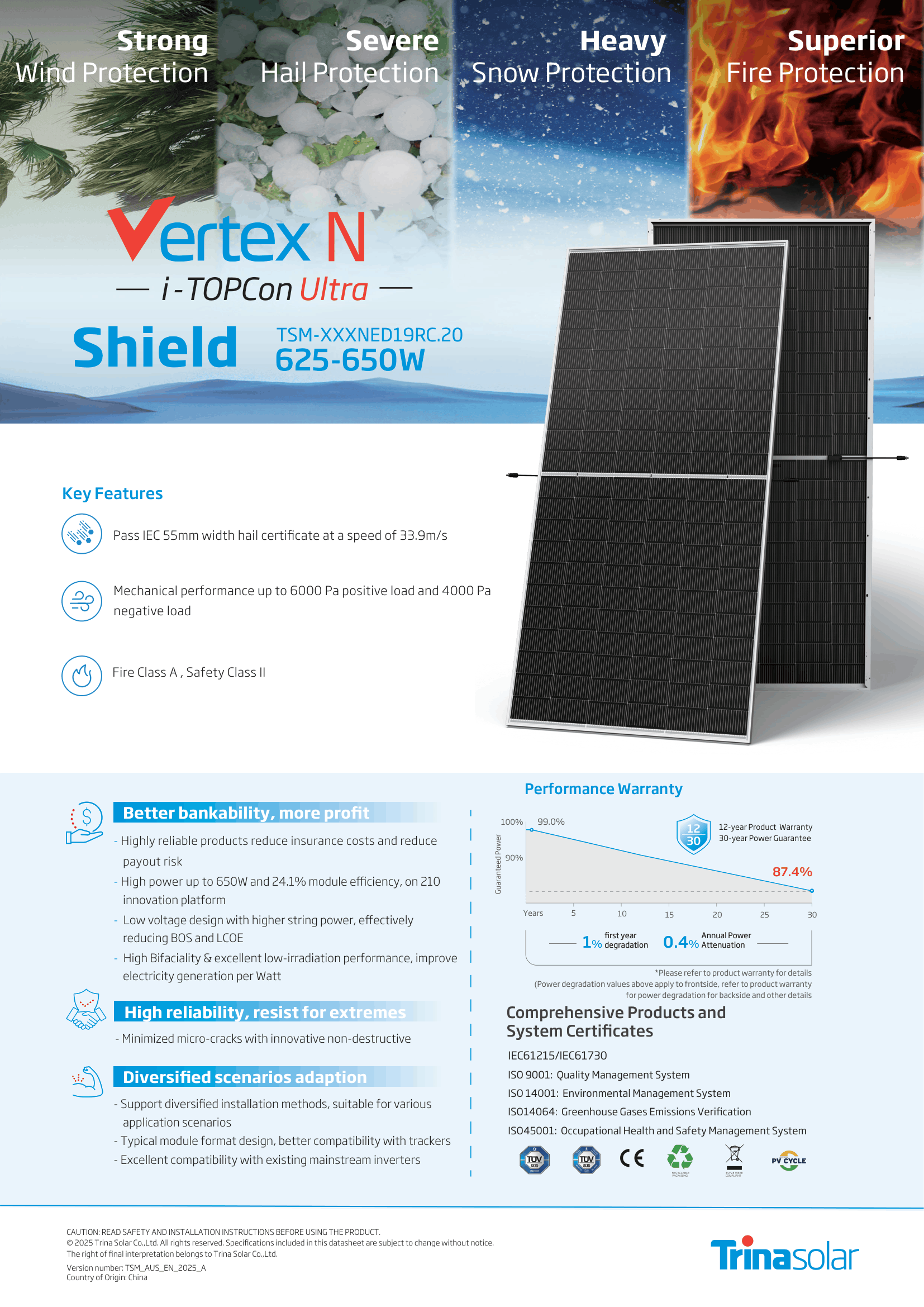
Selecting the correct panel size is a primary concern for residential properties. The latest Vertex S+ series, specifically the NEG18R.28 range, pushes residential power from 495W up to 525W.
These panels represent a practical and powerful upgrade. If you are searching for a reliable trina solar panels 500w option, the Vertex S+ delivers this output within a manageable frame. They are dual-glass modules, meaning the silicon cells are protected by tempered glass on both the front and the rear surfaces.
Despite this dual-glass protection, the NEG18R.28 models weigh an easily manageable 23.5 kilograms. This ensures installers can safely lift and mount them on pitched residential roofs. They also feature a Class C fire rating and Safety Class II, providing proven durability during the Australian bushfire season.
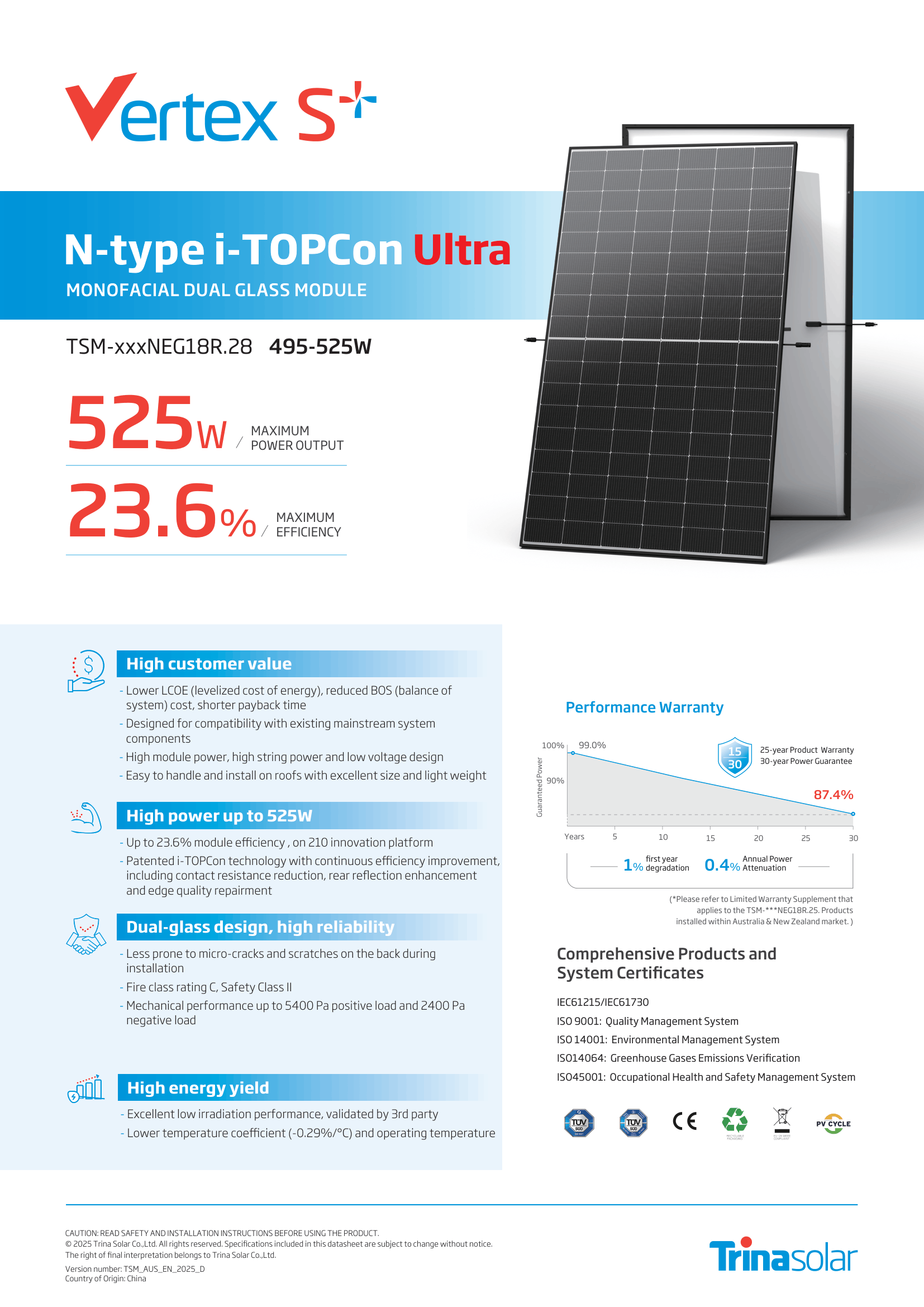
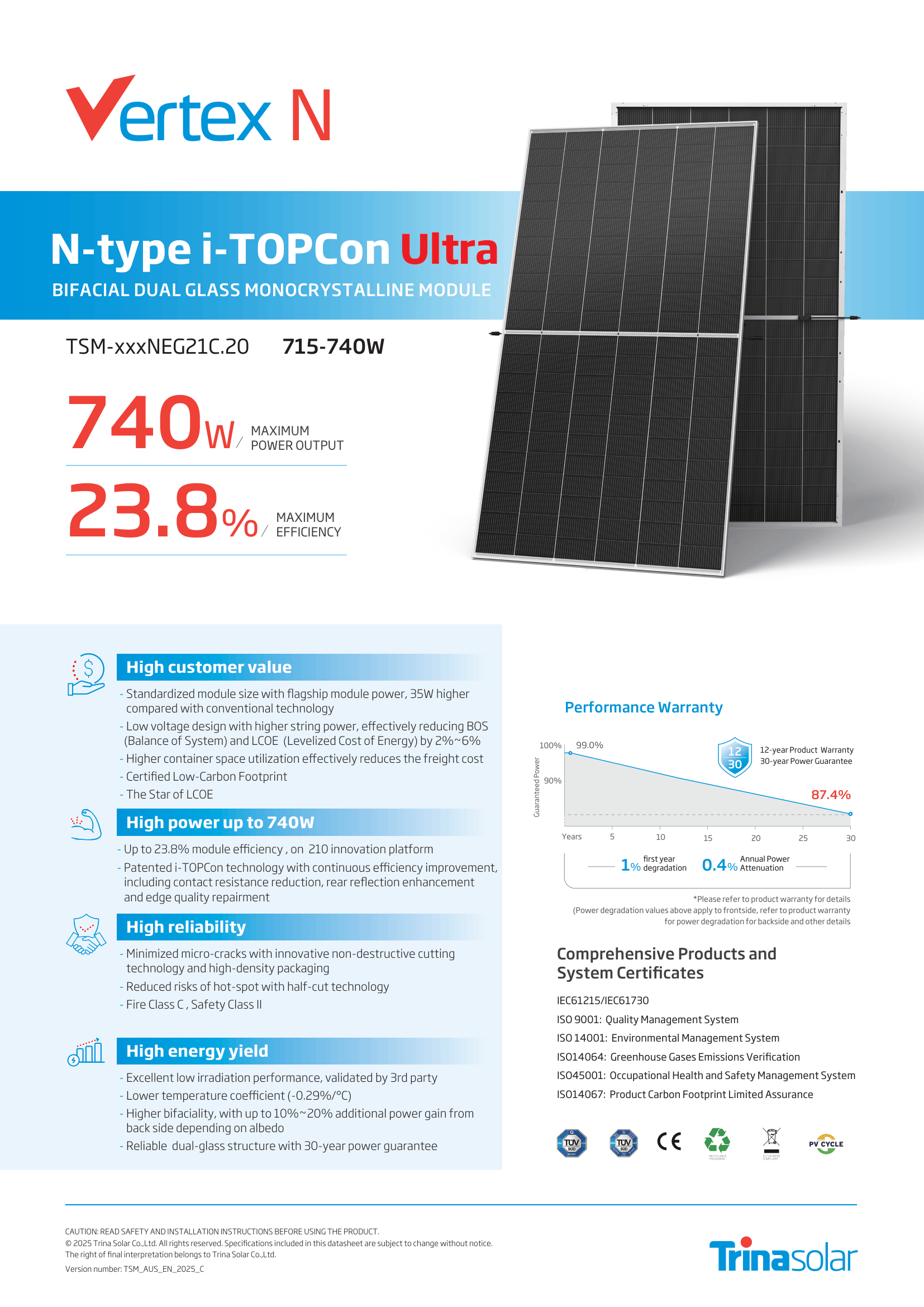
For commercial projects, raw power output alone is not enough. System efficiency and long-term operating costs matter just as much. The commercial range includes the Trina Vertex N NE19R series, which generates up to 650W. For true industrial applications, the NEG21C.20 series reaches between 715W and 740W.
These commercial modules use a low-voltage design. This design allows more panels to operate efficiently within the same electrical string. By increasing string capacity, facility managers can expect a reduction in the Levelized Cost of Energy by 1 to 5 per cent.
Additionally, the NED19RC.20 is engineered as an ideal partner for 1P trackers. This specific model offers excellent utilisation of tracker length, making it a smart and effective choice for regional utility-scale solar farms.
Anyone managing agricultural sites in the Hunter Valley or commercial roofs in regional NSW already knows how quickly dust builds up on outdoor equipment. When dirt pools at the bottom edge of a panel, it blocks sunlight and reduces electrical output.
Trina has addressed this operational hurdle directly with their anti-soiling frame technology. The NEG19RC.70 model features a patented short-edge frame design that minimises dust and snow accumulation. The frame sits flush with the glass, allowing rainwater to easily wash away debris without leaving a mud ridge.
Trina states this design can improve average energy yield by over 2 per cent in dusty environments. That may sound minor, but over a 25-year operational lifespan, it adds up significantly. It also reduces maintenance costs, as facility managers do not need to schedule manual cleaning services as frequently.
Australia experiences some of the most brutal weather patterns on the planet. Solar hardware must be built to survive strong wind, severe hail, and blistering heat. Specific Trina solar panels, such as the NED19RC.20, are certified to withstand 6000 Pa positive loads and 4000 Pa negative loads.
Certain commercial models also pass severe hail testing. They are certified to survive impacts from 55mm hailstones travelling at a speed of 33.9 metres per second. Furthermore, the Vertex N series features a temperature coefficient of -0.29%/°C. This ensures the panels lose very little power during a 40-degree summer heatwave compared to older modules.
Many homes in areas like the Northern Beaches or coastal NSW are located right near the ocean. Salt mist is corrosive and can damage solar wiring over time. Trina has specific installation rules to protect their hardware in these zones.
For installations within 50 to 500 metres of the coastline, dual-glass products are mandatory. Furthermore, connectors must be fitted with dust caps or protection boxes immediately upon unpacking. This prevents salt mist from corroding the electrical contacts before the system is even switched on.
At Opera Solar, our approach aligns with Trina’s official installation guidelines. One of the greatest risks to a solar panel is the hidden micro-crack.
Trina uses non-destructive cutting technology to slice their wafers. This smoother cutting process helps reduce the risk of hidden micro-cracks forming during manufacturing. However, handling on site is equally critical for long-term safety.
To protect the integrity of the silicon, installers must follow Trina’s handling protocols:
Following these handling protocols ensures the structural integrity of the silicon remains intact for decades.
Selecting the right solar panel is only the first step. To achieve stable performance, the modules should be paired with a capable inverter. Panels like the Vertex N and Vertex S+ generate significant electrical current. Depending on the exact specification, short circuit currents can reach 16.02 Amps for residential models and up to 20.68 Amps for large commercial models.
Pairing these modules with an undersized string inverter will result in electrical clipping. To extract steady yield, installers must select string inverters from proven brands like Fronius or Sungrow. Alternatively, pairing Trina residential panels with Enphase microinverters provides a resilient system, allowing each panel to operate independently.
During installation, the cabling must be managed carefully. Cables must adhere to a minimum bending radius of 43mm. Bending the cables too tightly will damage the internal insulation and introduce safety hazards.
A solar array is a long-term financial asset. You need complete transparency regarding how the equipment will perform over time. Looking closely at a trina solar panels data sheet reveals a solid and reliable warranty structure.
The dual-glass N-type models, such as the NEG18R.28, feature up to a 25-year product warranty and a 30-year performance guarantee. The degradation curve is mathematically precise. Trina guarantees that the panel will lose a maximum of 1 per cent of its capacity in the first year.
Following this initial year, the degradation is capped at just 0.4 per cent annually. This means your system is guaranteed to retain at least 87.4 per cent of its original generation capacity at the end of year 30. This predictable financial curve makes ROI calculations incredibly straightforward.
Objective comparison is necessary when evaluating solar hardware. No single brand is perfect for every scenario, and understanding the nuances helps buyers make informed decisions for their properties.
Compared with Jinko’s Tiger Neo range, Trina focuses heavily on their 210R rectangular wafer and i-TOPCon Ultra technology. The 210R shape optimises the active silicon area effectively. Both are outstanding Tier 1 options, but Trina often provides an edge in physical roof space optimisation.
When evaluating trina solar panels vs ja solar, JA Solar uses gapless flexible interconnection to improve cell density. Trina focuses on non-destructive cutting and anti-soiling frames. Trina is a very practical choice for regional areas where dust accumulation is a serious ongoing maintenance issue.
When comparing trina solar panels vs canadian solar panels, Canadian Solar is competitive on raw upfront pricing. However, Trina generally leads in advanced dual-glass architecture and severe hail resistance ratings for their specific N-type lines.
When researching Trina solar panels review complaints, it is helpful to separate actual hardware failure from poor installation practices. The majority of negative feedback regarding Trina panels relates to the physical weight of their older dual-glass modules.
Installers occasionally noted that heavy dual-glass panels were difficult to lift onto steep pitched roofs. However, Trina has addressed this with the modern Vertex S+ series, bringing the weight down to a manageable 23.5 kilograms.
Other complaints stem from improper installation practices. Rough handling that causes micro-cracks, or failing to install dust caps in coastal areas, will void warranties and reduce output. When installed by a meticulous engineering team, Trina panels are exceptionally reliable.
For many Australian homeowners and commercial investors, Trina Solar represents a very strong balance of efficiency, durability, and long-term financial value. Their shift to N-type i-TOPCon Ultra cells delivers reliable efficiency, while their anti-soiling frames provide a tangible maintenance advantage for regional Australian sites.
Their 0.4 per cent annual degradation curve ensures your solar system will yield strong financial returns long into the future. Contact the technical team at Opera Solar to design a custom Vertex array that practically matches your property’s exact energy requirements today.
Yes. They are a recognised Tier 1 manufacturer. Their internal testing protocols go beyond standard requirements, ensuring their panels survive extreme weather events and maintain stable voltage over decades.
Both are excellent, proven brands. Trina Solar stands out with their 210R rectangular wafer, which optimises active silicon area, and their unique anti-soiling frames. Jinko is also highly capable, but Trina offers specific design advantages for dusty environments.
Most complaints relate to the physical weight of their older commercial dual-glass panels or errors made by rushed installation teams. Actual manufacturing hardware failures from the factory are rare.
Trina operates automated manufacturing facilities primarily in China. They distribute their photovoltaic products globally and maintain strict quality control standards across all their factories.
Bifacial panels are slightly heavier due to the dual-glass construction. They are also less effective when installed flush against a residential tin roof, as no light can reach the rear side. They perform best on tilt frames or open ground mounts.
They handle it well. Specific models like the NED19RC.20 are certified to withstand 55mm hailstones striking the glass at 33.9 metres per second.
While older Trina solar panels 440w stock may exist on the market, the new 2026 standard for residential roofs is the Vertex S+ series. This series pushes output from 495W to 525W, allowing you to generate more power with fewer panels on your roof.
It is a patented short-edge design that prevents a lip from forming at the bottom of the panel. This stops dust and mud from accumulating, boosting average energy yield by over 2 per cent.
Standard laser cutting can create microscopic thermal damage on silicon edges. Trina uses a low-temperature cutting process that leaves the silicon edge smooth. This prevents hidden micro-cracks from forming over time.
The dual-glass N-type models feature up to a 25-year product warranty. This is paired with a robust 30-year performance guarantee.
Yes, they pair well. Because Trina panels generate high electrical current, pairing them with premium Enphase microinverters ensures safe power conversion and reduces the risk of electrical clipping.
They perform reliably. The Vertex N series features a temperature coefficient of -0.29%/°C. This means they lose very little power during extreme summer heatwaves compared to older P-type panels.